Rockville RW8CA/RW10CA Powered Subwoofer Manual
Panel controls and features
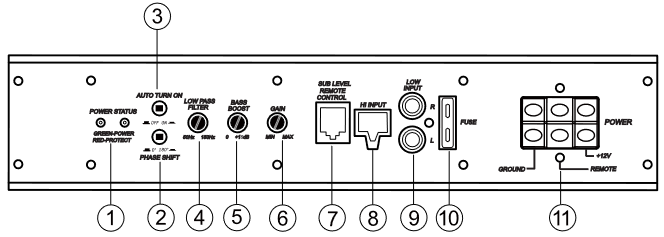
- POWER STATUS LED
This bi-colour LED glows green when power is on and no problems are present. If one of the protection circuits comes on, it will change to red. - PHASE SHIFT
Use this switch to help compensate for time alignment problems in the system. Such problems usually result from having the subwoofer at a different distance from the listener than the other speakers in the system. - AUTO POWER ON
The AUTO POWER ON (ON / OFF) is for high level (speaker-level) connections. When the switch is in the "ON" position, the subwoofer will AUTO POWER ON when there is signal input. If the amplifier detects no signal input, it will auto turn off. If you prefer to use the remote turn on/off connection, the switch should be in the OFF position. - LOW PASS FILTER
This control permits you define the frequency range you want the subwoofer amplifier to receive. The subwoofer will reproduce all sound BELOW the frequency you set. If the rest of your system is weak on the mids, you may wish to set this control relatively high. If the midrange is well covered by the rest of your system, you will probably want the subwoofer to only receive lower frequency signal. - BASS BOOST
The bass boost feature will increase the sound level in the bass frequencies. - INPUT GAIN CONTROL
After you have installed your system, turn this control to minimum. Turn the head unit on ( the subwoofer will turn on via the remote connection). Turn the head unit volume to about 2/3 full level. Slowly turn up the subwoofer input gain control until you hear a small amount of distortion. Then reduce the level until the distortion is completely gone. Level the control at this setting. - REMOTE LEVEL CONTROL PORT
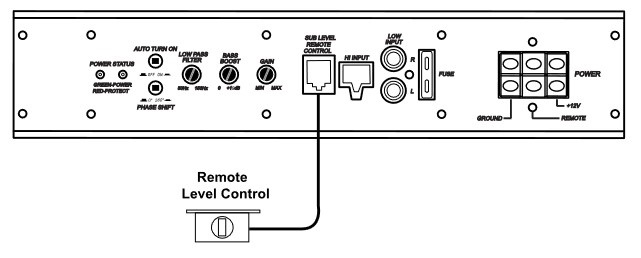
Attach the included remote level control to control the volume level of the subwoofer independently. - HIGH LEVEL (speaker level) INPUTS
If your head unit does not have RCA outputs, you can use the speaker outputs for the audio source for the subwoofer. Use the supplied cable and wire harness and connect the outputs properly as shown in the connection diagram in this manual - LOW LEVEL RCA INPUTS
Low level inputs are the recommended way to introduce the audio signal to the subwoofer if RCA outputs are present on your head unit or other signal source (such as a sound processor). - FUSE
RW8C uses a 15 Amp fuse. RW10CA uses a 25 Amp fuse. Always replace fuses with the specified amperage fuse. Use of a higher amperage fuse may cause serious damage. - POWER TERMINALS
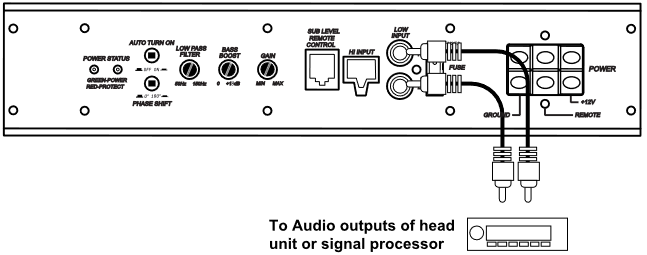
Low Level Input Wiring
Low-level (RCA) input wiring is preferred for best audio performance. Most boot or hatchback installations will require a 15-20 feet RCA cable, while pickup trucks and under-seat installations will require a 6-12 feet RCA cable. Always use a high quality cable.
NOTE: Do not connect BOTH the high level and low level inputs from your receiver to your amplifier at the same time!
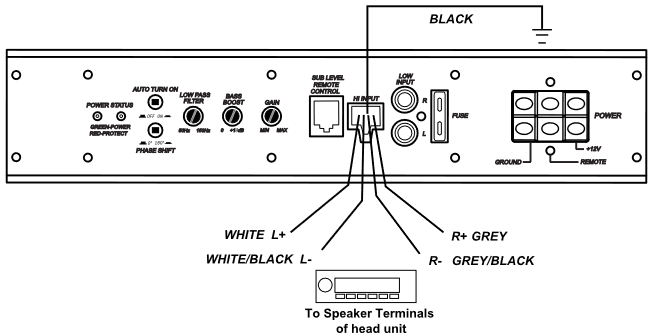
High Level Input Wiring
The high level input(s) should only be used when your receiver lacks RCA outputs. If the RCA outputs are not present, connect the speaker outputs from the receiver to the high level input connector of the amplifier. Be sure to observe polarity to avoid audio phase problems.
NOTE: Do not connect BOTH the high level and low level inputs from your receiver to your amplifier at the same time!
Power Connections
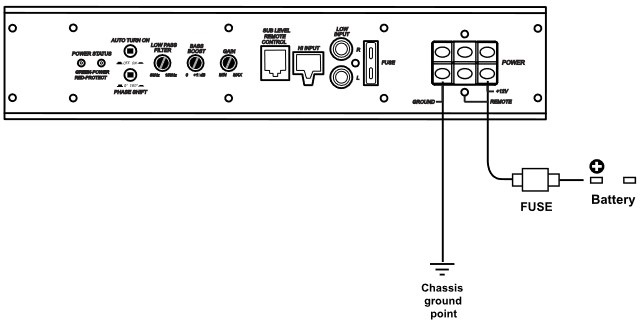
Connect the ground terminal to the closest point on the chassis of the vehicle.
Keep this ground wire to less than 39" (100 cm) in length. Use 10 gauge (or heavier) wire.
Connect the remote terminal to the remote output of head unit using 16 gauge ( or heavier ) wire.
Connect an empty fuse holder within 18" (45 cm) of the car battery, and run 10 gauge (or heavier) cable from this fuse to the amplifier location. Then connect the fuseholder to the "BATT+" (+12V) connection on the subwoofer rear panel.
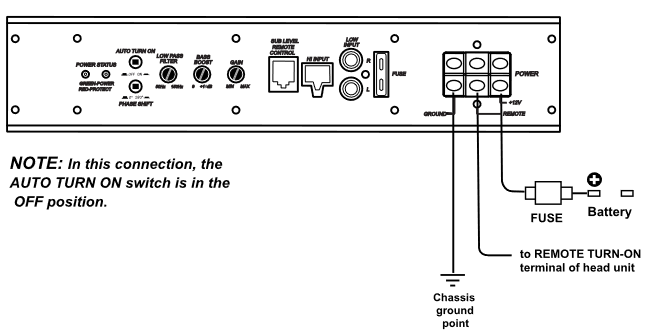
NOTE: In this connection, the AUTO TURN ON switch is in the OFF position.
If you use high level inputs, AUTO TURN ON switch in the "ON" position, the subwoofer auto turn on when there is signal input, this connection is input signal control subwoofer TURN-ON or TURN-OFF. If subwoofer detected no speaker-level input, the subwoofer will TURN - OFF. if you prefer remote turn on / turn off connection, the switch is in the OFF position.
Remote Level Control Connection
Install the remote control securely under the dash or in a similar location where using it will not distract the driver.
Specifications
| MODEL: | RW8CA | RW10CA |
| Max power | 600W | 800W |
| THD | <0.4% | <0.4% |
| Signal-to-noise ratio | >95dB | >95dB |
| Frequency response | 20Hz - 150Hz | 20Hz - 150Hz |
| Input sensitivity, high level | 0.61V | 0.61V |
| Input sensitivity, low level | 200mV | 200mV |
| Low Pass Filter | 50Hz - 150Hz | 50Hz - 150Hz |
| Bass Boost | 0 to + 18dB | 0 to + 18dB |
| Fuse rating | 15A | 25A |
| Subwoofer | 8inch | 10inch |
| Dimensions(L x W x H) in / mm | 12.4 x 11 x 2.7 ( 314 x 280 x 68) | 12.4 x 13.4x 2.7 (314 x 340 x 68) |
All specifications subject to change without notice.
Troubleshooting
If you experience operation or performance problems with this product, compare your installation with the electrical wiring diagram on the previous pages. If problems persist, read the following troubleshooting tips which may help eliminate the problems.
| SYMPTOM | POSSIBLE REMEDY |
Amplifier will not power up | Check to make sure you have a good ground connection. Check that the Remote Input (Turn-On) has at least 5VDC. Check that there is battery power on the (+) terminal. Check that there is at least 12v. Check all fuse, replace if necessary. Make sure that the Protection LED is not illuminated. If it is lit, shut off the amplifier briefly, and then repower it. |
Protection LED comes on when amplifier is powered up | Check for short circuits on speaker leads. Turn down the volume control on the head unit to prevent overdriving. Remote speaker leads, and reset the amplifier. If the Protection LED still comes on, then the amplifier is faulty and needs servicing. |
No output | Check that all fuses are OK. Check that unit is properly grounded. Check that the Remote Input (Turn-On) has at least 5VDC. Check that the RCA audio cables are plugged into the proper inputs. Check all speaker wiring. |
Low output | Reset the Level Control. Check the Crossover Control settings. |
High hiss in the sound | Disconnect all RCA inputs to the power sub's control panel. If the hiss disappears, then plug in the component driving the amplifier and unplug its inputs. If the hiss disappears at this point, go on until the faulty/noisy component is found. It is best to set the amplifier's input level control as low as possible. The best subjective signal-to-noise ratio is achieved in this manner. Try to set the head unit as high as possible (without distortion) and the amp input level as low as possible. |
Squealing noise is present | Check for improperly grounded RCA interconnects. |
Distorted sound | Check that the Input Level Control is set to match the signal level of the head unit. Always try to set the Input Level as low as possible. Check that all crossover frequencies are properly set. Check for short circuits on the speaker leads. |
Amplifier gets very hot | Check that the minimum speaker impedance for the amp model is correct. Check that there is good air circulation around the amp. In some applications, it may be necessary to add and external cooling fan. |
Engine noise (static type) | This is usually caused by poor quality RCA cables, which can pick up radiated noise. Use only the best quality cables, and route them away from power cables. |
Engine noise (alternator whine) | Check that the RCA grounds are not shorted to the vehicle chassis Check that the head unit is properly grounded. |

Download manual
Here you can download full pdf version of manual, it may contain additional safety instructions, warranty information, FCC rules, etc.
Download Rockville RW8CA/RW10CA Powered Subwoofer Manual
