GIGABYTE M32Q - Gaming Monitor Manual
INTRODUCTION
Unpacking
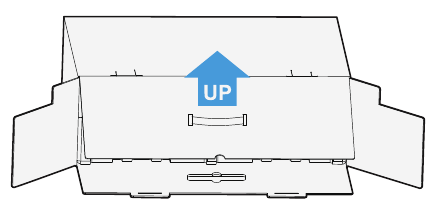
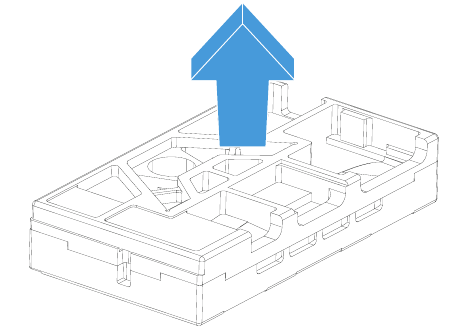
- Open the upper cover of the packaging box. Then observe the unpacking instruction attached on the inner cover. Making sure the box is in the correct orientation, carefully lay the box on the stable surfacepen.

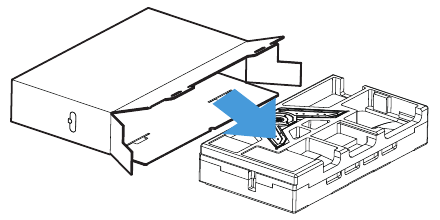
- Open the inner cover. Grab the EPS foam assembly (through the openings) to pull it out of the box.

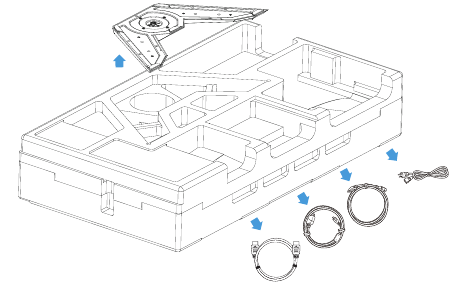
- Remove the items from the upper EPS foam.

- Remove the upper EPS foam. Then you can remove the stand from the lower EPS foam.

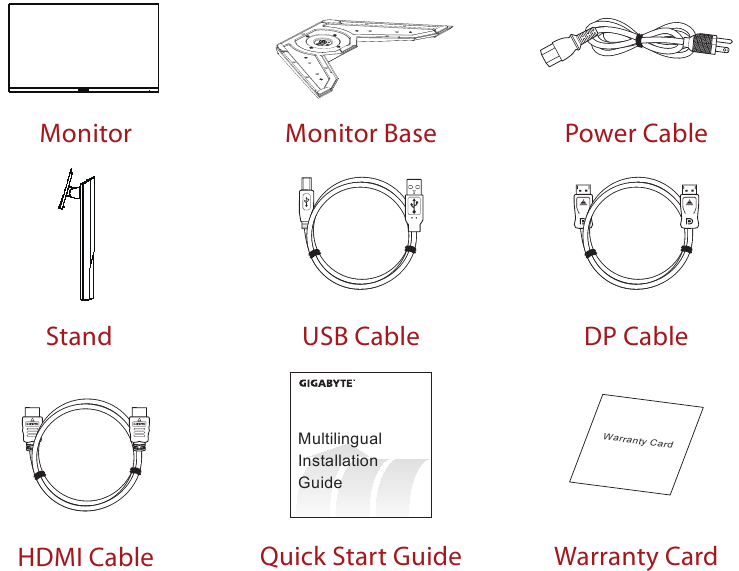
Package Contents
The following items come with your packaging box. If any of them is missing, please contact your local dealer.
Note: Please keep the packaging box and packing materials for future transportation of the monitor.
Product Overview
Front View
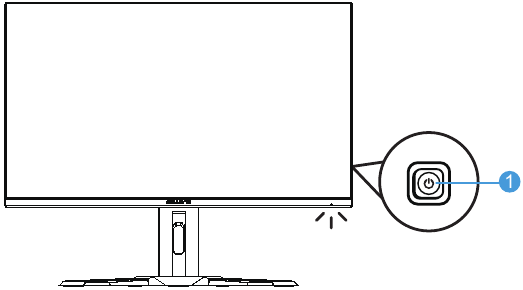
- Control button
Rear View
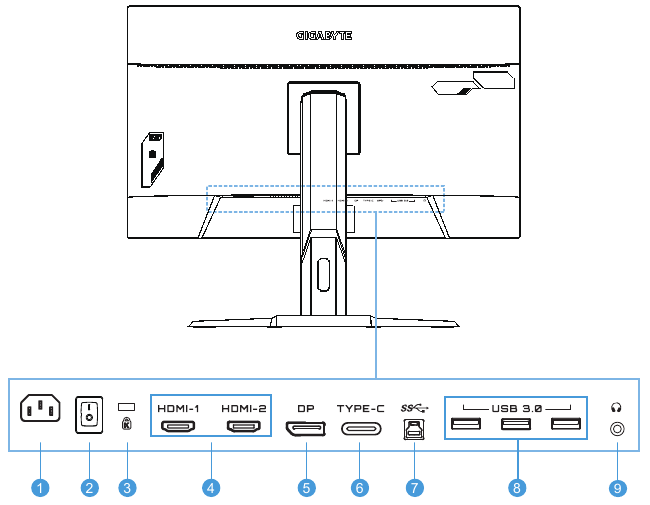
- AC IN jack
- AC power switch
- Kengsington lock
- HDMI ports (x2)
- DisplayPort
- Type-C
- USB upstream port
- USB 3.0 ports (x3)
- Headphone jack
GETTING STARTED
Installing the Stand Base
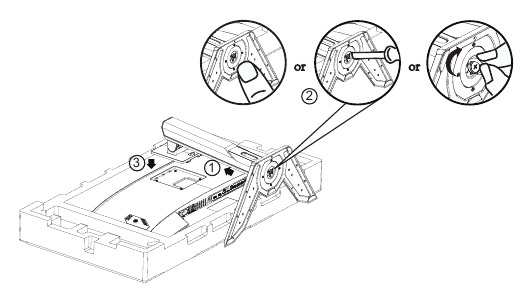
- Align the Stand base with the stand off underneath the stand. Then attach the base onto the stand. Tighten the screw to secure the monitor base in place.

Note: You can either use a coin or a small flathead screwdriver to tighten the screw. - Place the monitor on the package cushion or a flat surface, with screen facing down. Tear apart the EPE bag, install the stand on the rear side of the monitor. Then you can take the monitor from the lower EPS foam by holding the stand arm. Carefully lift the monitor. Place it upright on a table.

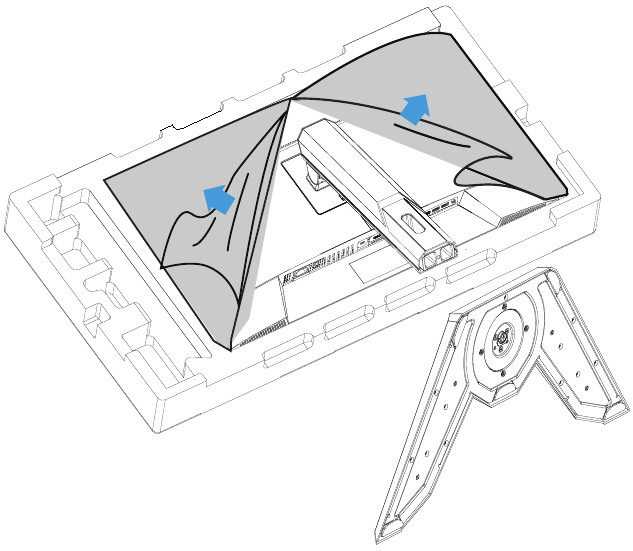
Lift the monitor
Take the monitor out of the box by holding the stand arm. Carefully lift the monitor, turn it over and place it upright on its stand on a flat even surface. Remove the foam wrap from the monitor.
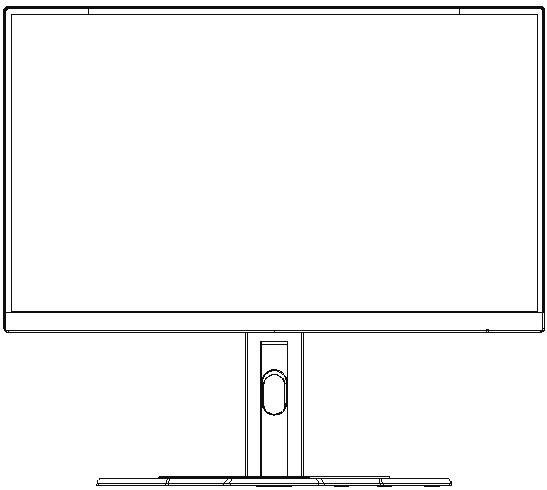
Note: Consider keeping the box and packaging in storage for use in the future when you may need to transport the monitor. The fitted foam packing is ideal for protecting the monitor during transport.
Adjusting the Viewing Angle
Note: Hold the monitor base so that the screen does not topple when you make the adjustment.
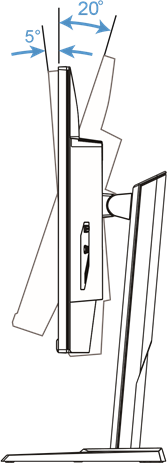
Adjusting the Tilt Angle
Tilt the screen forward or backward to the desired viewing angle (-5˚ to 20˚).
Changing the Screen Orientation
Raise the screen to the highest position (130mm).
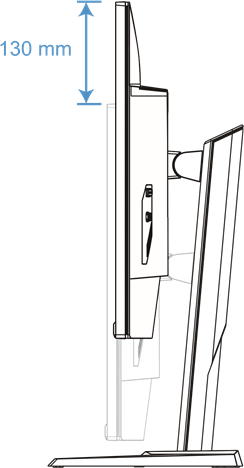
Note: Before making the height adjustment, make sure you have removed the safety plate from the stand.
Installing a Wall-Mount Bracket (Optional)
Use only the 100 x 100 mm VESA compatible wall mount kit.
- Place the monitor on a flat surface, with the screen facing down.
Note: We recommend that you cover the table surface with soft cloth to prevent damage to the monitor. - Push the locking clips inward to detach the stand from the monitor.

- Remove the stand.

- Attach the mounting bracket to the mounting holes at the rear of the monitor. Then use the screws provided with the wall mount kit to secure the bracket in place.

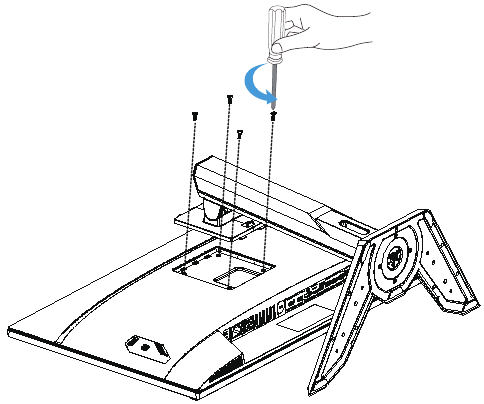
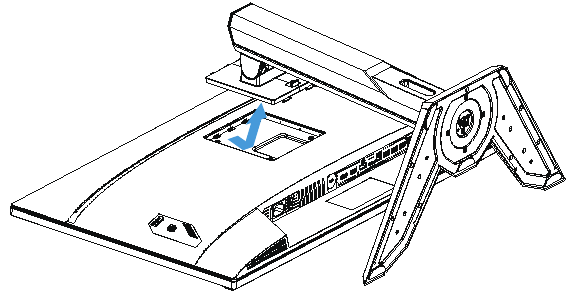
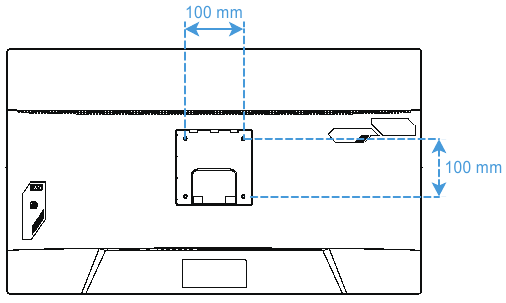
Note: To mount the monitor on the wall, refer to the installation guide that is included in the wall-mount bracket kit. VESA mounting screw size: M4 x 15mm minimum.
Making Connections
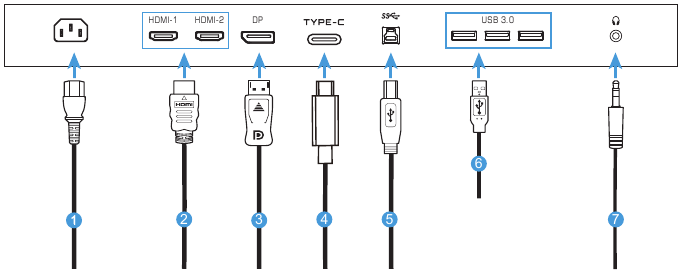
- Power cable
- HDMI cable
- DisplayPort cable
- Type-C cable
- USB (A-Male to B-Male) cable
- USB cable
- Headphone cable
USING THE DEVICE
Turning the Power On/Off
Make sure the power switch next to the AC power input jack is switched to ON.
Power On
- Connect one end of the power cable to the AC IN jack at the rear of the monitor.
- Connect other end of the the power cable to a power outlet.
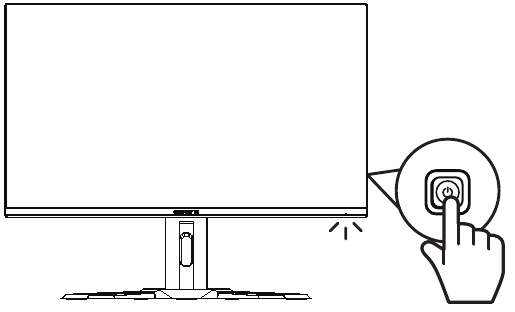
- Press the Control button to turn on the monitor. The Power LED will light in white, indicating the monitor is ready to use.

Power Off
Press the Control button for 2 seconds to turn off the monitor.
Note: When the Main menu appears on the screen, you can also turn off the monitor by moving the Control button down (  ).
).
User Comfort Recommendations
The following are some tips for comfortable viewing of your monitor:
- Optimal viewing distances for monitors range from approximately 510 mm to 760 mm (20" to 30").
- A general guideline is to position the monitor such that the top of the screen is at or slightly below your eye-height when you are comfortably seated.
- Use adequate lighting for the type of work you are performing.
- Take regular and frequent breaks (at least for 10 minutes) every half- hour.
- Be sure to periodically look away from your monitor screen and focus on a far object for at least 20 seconds during the breaks.
- Eye exercise can help reduce eye strain. Repeat these exercises frequently:
- look up and down
- slowly roll your eye
- move your eyes diagonally.
Selecting the Input Source
- Move the Control button right (
![]() ) to enter the Input menu.
) to enter the Input menu. - Move the Control button center (
![]() ) to select the desired input source. Then press the Control button to confirm.
) to select the desired input source. Then press the Control button to confirm.

 ) to enter the Input menu.
  ) to select the desired input source. Then press the Control button to confirm.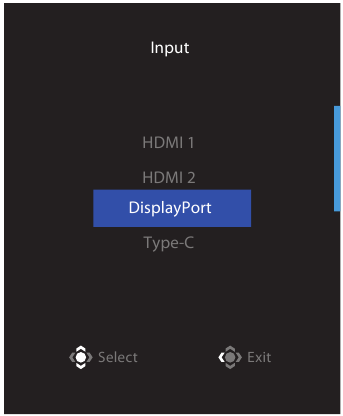
OPERATIONS
Quick Menu
Hot Key
By default, the Control button has been assigned with the specific function.
Note: To change the preset hot key function, refer to the "Quick Switch".
To access the hot key function, do the following:
- Move the Control button up (
![]() ) to enter the Black Equalizer menu.
) to enter the Black Equalizer menu.
Move the Control button up/down (![]() ) to adjust the setting and press the Control button to confirm.
) to adjust the setting and press the Control button to confirm.

- Move the Control button down (
![]() ) to enter the Picture Mode menu.
) to enter the Picture Mode menu.
Move the Control button center (![]() ) to select the desired option and press the Control button to confirm.
) to select the desired option and press the Control button to confirm.

- Move the Control button left (
![]() ) to enter the Volume menu. Move the Control button up/down (
) to enter the Volume menu. Move the Control button up/down ( ![]() ) to adjust the headphone volume level and press the Control button to confirm.
) to adjust the headphone volume level and press the Control button to confirm.

- Move the Control button right (
![]() ) to enter the the Input menu. Refer to the "Selecting the Input Source" section.
) to enter the the Input menu. Refer to the "Selecting the Input Source" section.

 ) to enter the Black Equalizer menu.
 ) to adjust the setting and press the Control button to confirm.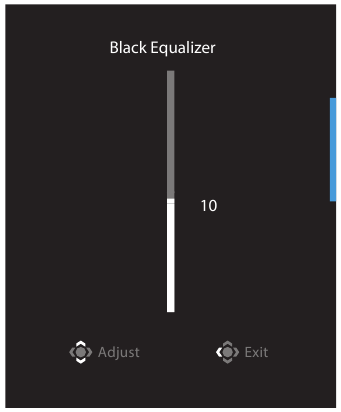
 ) to enter the Picture Mode menu.
 ) to select the desired option and press the Control button to confirm.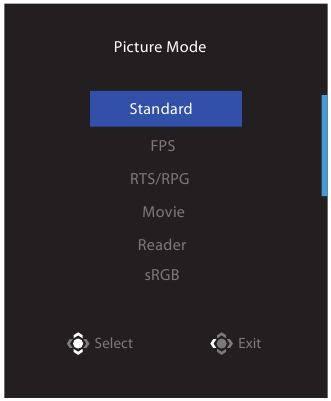
 ) to enter the Volume menu. Move the Control button up/down (
  ) to adjust the headphone volume level and press the Control button to confirm.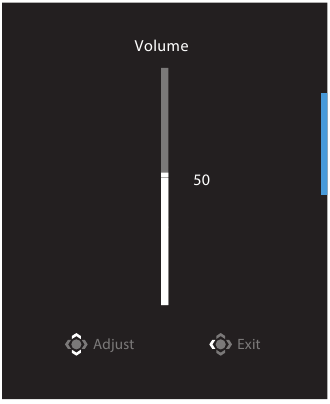
 ) to enter the the Input menu. Refer to the "Selecting the Input Source" section.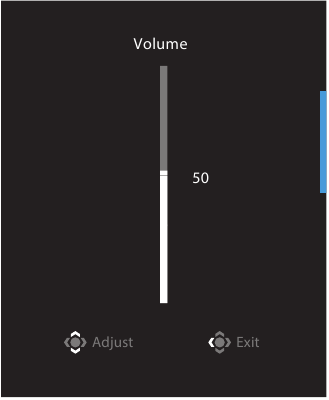
Note: To close the menu, move the Control button left (  ).
).
Function Key Guide
- Press the Control button to display the Main menu.

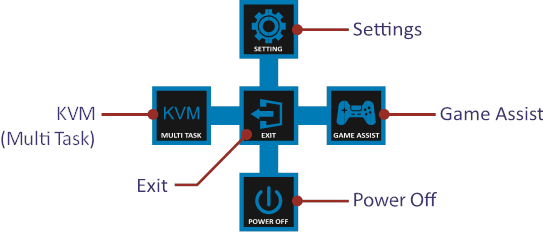
Then use the Control button to select the desired function and configure the related settings.
KVM
When the Main menu appears on the screen, move the Control button left (  ) to enter the KVM menu.
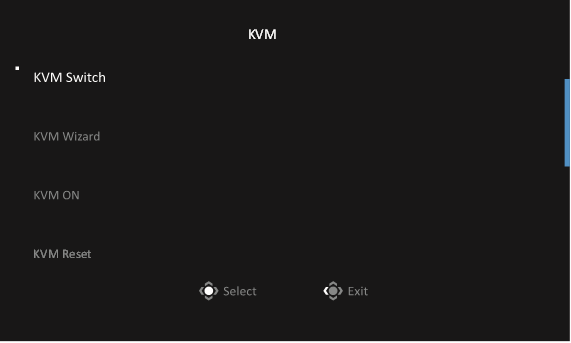
- KVM Switch: Switch the input source that has been assigned to USB-B or Type-C connection in the KVM Wizard settings.
When there are several input signals connected to the device, a message box will appear on the screen once the system detected USB Type-C input signal.
![]()
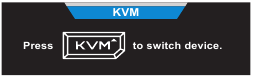
To switch to USB Type-C input source, simply press the KVM button or the Control button.
However, when there is no input signal from currently selected input source, the system will return to the previous connected input source.
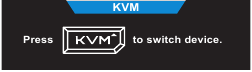
Note: This option will be disabled if the KVM button function is disabled (KVM OFF).
- KVM Wizard: Configure the KVM related settings.
Set the input source to be bound with USB Type-B connection first, and then following with USB Type-C connection.
![]()
USB-B Display Selection
![]()
TYPE-C Display Selection
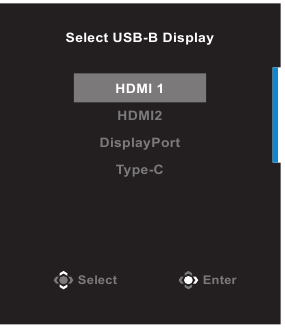
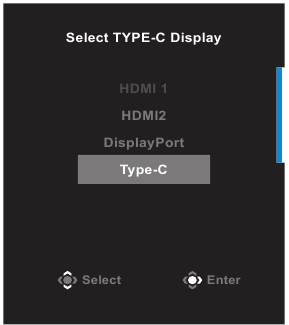
Note: If you set the USB-B Display setting to Type-C, the TYPE-C Display menu option will automatically be disabled. You will then see the KVM status in the KVM Wizard page as below.
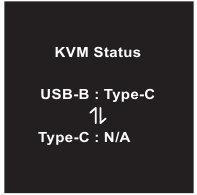
- KVM ON/OFF: Enable/Disable the KVM button function.
- Select ON to enable the KVM button function. Once the system detected USB Type-C input signal, a message box will appear on the screen.
![]()
Press the KVM button or the Control button to switch to USB Type-C input source.
Note: When the KVM button function is enabled, the KVM ON will be displayed on the left panel. - Select OFF to disable the KVM button function.
Note: When the KVM button function is disabled, the KVM OFF will be displayed on the left panel.
- Select ON to enable the KVM button function. Once the system detected USB Type-C input signal, a message box will appear on the screen.
- KVM Reset: Restore the KVM default settings.
- HDMI 1 input source is bound with USB Type-B connection.
- USB Type-C input source is bound with USB Type-C connection.
- The KVM ON/OFF function is set to ON.
Game Assist
- When the Main menu appears on the screen, move the Control button right (
![]() ) to enter the Game Assist menu.
) to enter the Game Assist menu.

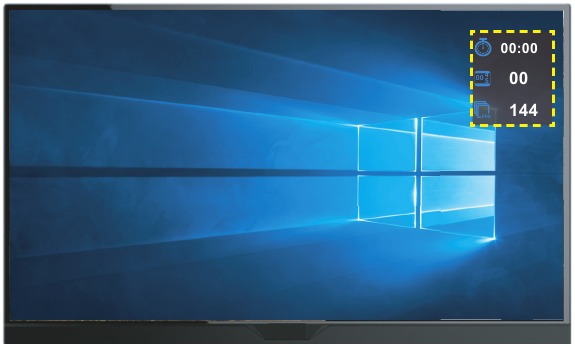
- Game INFO: Configure the FPS (First Person Shooting) game related settings.
- Select Gaming Timer to select countdown timer mode. To disable this function, set the setting to OFF.
- Select Gaming Counter or Refresh Rate to enable/disable the gaming counter or real-time refresh rate setting.
- Select Info Location to specify the location of the information to be shown on the screen.

- Crosshair: Select the desired crosshair type to suit your gaming environment. It makes aiming much easier.
- Eagle Eye: Enlarge certain area of the screen.
- Dashboard: Configure the dashboard settings.

- ON: Enable the function. Then select the desired option(s) to be shown on the screen.
- OFF: Disable the function.
- Dashboard Location: Specify the location of the Dashboard information to be shown on the screen. Once the Dashboard configuration is complete, it will transfer the system data to the SOC through the USB port and display the value of the selected function(s) on the screen.

 ) to enter the Game Assist menu.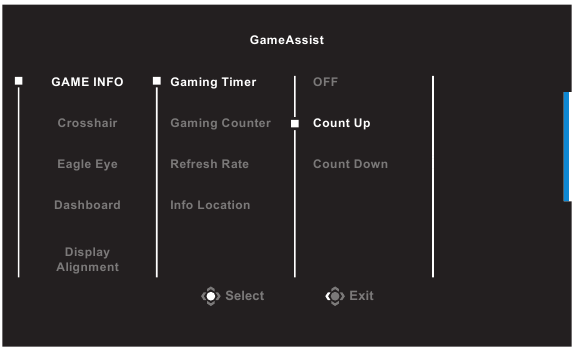

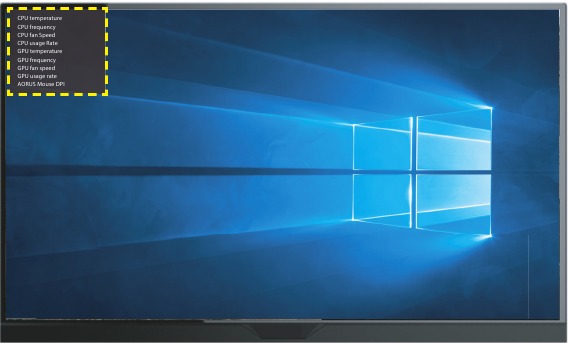
Note: Make sure the USB cable is properly connected to the USB upstream port of the monitor and the USB port of your computer.
- Display Alignment: When the function is enabled, it displays the alignment lines on the four sides of the screen, providing handy tool for you to line up multiple monitors perfectly.
Configure the Device Settings
When the Main menu appears on the screen, move the Control button up ( ) to enter the Settings menu.
Note: Use the Control button to navigate through the menu and make adjustments.
Gaming
Configure the game related settings.
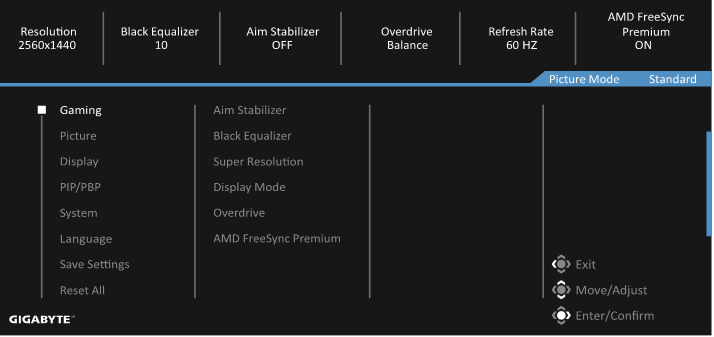
| Item | Description |
| Aim Stabilizer | When this function is enabled, it reduces the motion blur in a fast moving games. Note: This function is not available under the following conditions:
|
| Black Equalizer | Adjust the brightness of the black areas. |
| Super Resolution | Sharpen the low resolution images. |
| Display Mode | Select the aspect ratio of the screen.
|
| Overdrive | Improve the response time of the LCD monitor. |
| AMD FreeSync Premium | When this function is enabled, it eliminates the screen lag and tearing while playing games. |
Picture
Configure the image related settings.
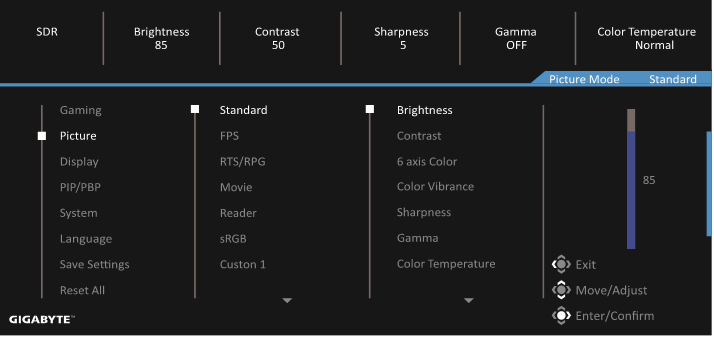
| Item | Description |
| Standard | For editing documents or browsing websites. |
| FPS | For playing FPS (First Person Shooting) games. |
| RTS/RPG | For playing RTS (Real-Time Strategy) or RPG (Role-Playing Game) games. |
| Movie | For watching movies. |
| Reader | For viewing documents. |
| sRGB | For viewing photos and graphics on the computer. |
| Custom 1 | Customized picture mode settings. |
| Custom 2 | Customized picture mode settings. |
| Custom 3 | Customized picture mode settings. |
Note: The Monitor use low blue light panel and compliance with TÜV Rheinland Low Blue Light Hardware Solution at factory reset/default setting mode (Brightness: 70, Contrast: 50, CCT: 6500, Preset mode: Standard mode).
Display
Configure the display screen related settings.
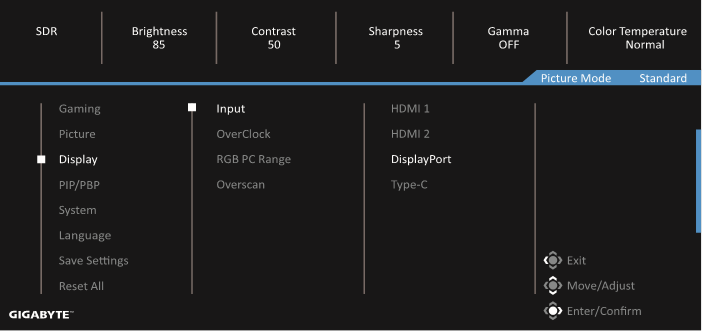
| Item | Description |
| Input | Select the input source. |
| OverClock | Enable to apply higher refresh rate. Note: When Overclocking is enabled. The monitor may result in flicker or other adverse effects that may derive from the total configuration of the system and possibly the display's panel specifications. It is possible to reduce such effects by setting a lower refresh rate. |
| RGB PC Range | Select an appropriate RGB range setting or let the monitor to detect it automatically. |
| OverScan | When this function is enabled, it slightly enlarges the input image to hide the outermost edges of the image. |
PIP/PBP
Configure the multi-picture related settings.
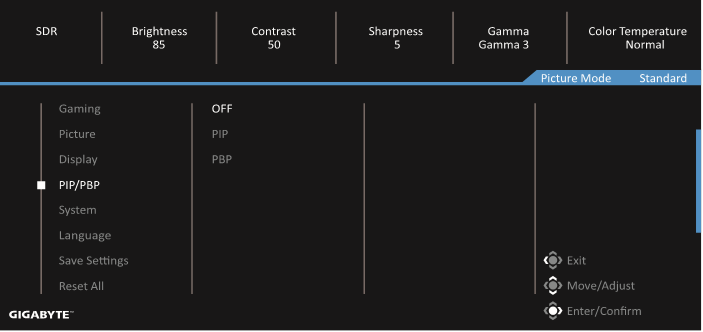
| Item | Description |
| OFF | Disable the PIP/PBP function. |
| PIP | Split the screen into 2 parts (main window and inset window).
|
| PBP | Display 1x1 split screen (left and right windows).
|
System
Configure the system related settings.
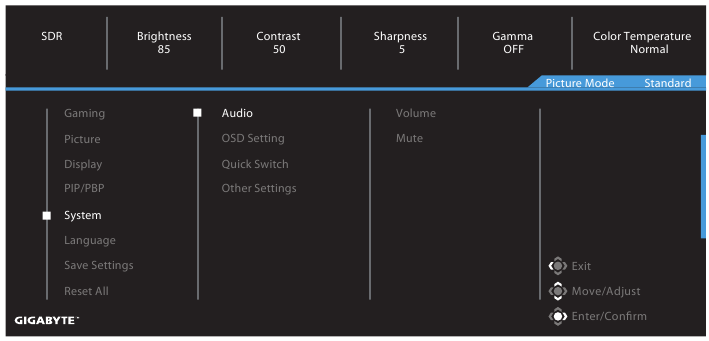
| Item | Description |
| Audio | Configure the headphone settings.
|
| OSD Settings OSD Settings (continue) | Configure the on-screen display (OSD) menu related settings.
|
| Quick Switch | Assign the function of the hot keys. Available options: Aim Stabilizer, Black Equalizer, Low Blue Light, Volume, Input, Contrast, Brightness, and Picture Mode. The default setting of the hot keys as below:  Up ( Up ( ): Black EqualizerDown ( ): Black EqualizerDown ( ): Picture ModeRight ( ): Picture ModeRight ( ): InputLeft ( ): InputLeft ( ): Volume ): Volume |
| Other Settings |
|
Language
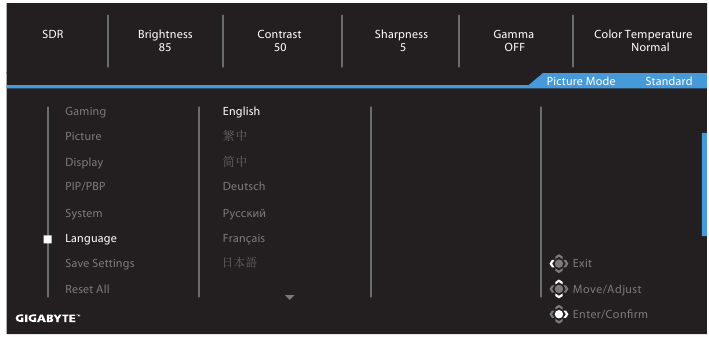
| Item | Description |
| Language | Select an available language for the OSD menu. |
Save Settings
Save all data.
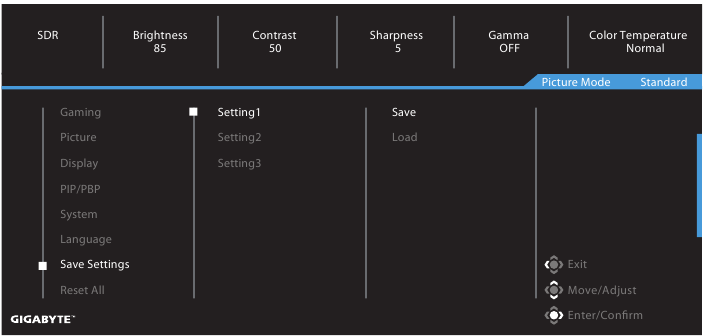
| Item | Description |
| Setting1 | After selecting, the Save and Load menu will appear for the player to choose. |
| Setting2 | After selecting, the Save and Load menu will appear for the player to choose. |
| Setting3 | After selecting, the Save and Load menu will appear for the player to choose. |
Reset All
Restore the monitor to its factory default settings.
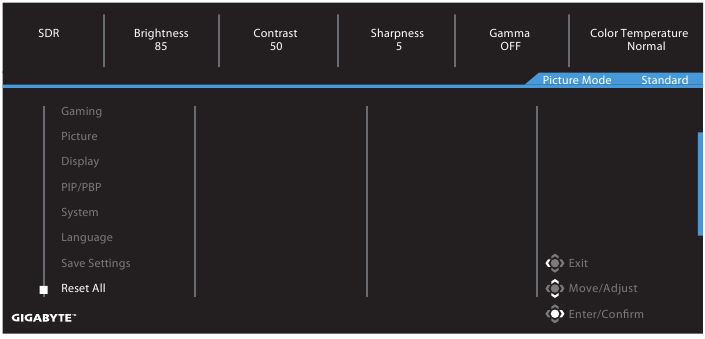
Specifications
| Item | Specifications |
| Panel Size | 32-inch |
| Aspect Ratio | 16:9 |
| Resolution | 2560 x 1440 |
| Refresh Rate | 165Hz |
| LED Life | 30000 hours (min.) |
| Pixel Pitch | 0.273(H) x 0.273(V) |
| Brightness | 350 nits (typ.) / 400 nits (peak) |
| Contrast Ratio | 1000:1 (typ.) |
| Color Depth | 16.7M ( 8Bit) |
| Active Display area | 698.112(H) x 392.688(V) |
| Viewing Angle | 178°(H)/178°(V) |
| Frequency | 48~165Hz |
| Input/Output Terminals |
|
| Power Supply | AC 100 ~ 240V at 50/60Hz |
| Power Consumptions |
|
| Dimensions (W x H x D) | 715 x 584 x 244mm(with stand) |
| Weight | 10.2 kg (Net) |
| Temperature Range (operation) | 0°C to 40°C |
Note: Specifications subject to change without notice.
Supported Timing List
| Port | QHD | Port | QHD |
| HDMI | 640x480@60Hz | DP | 640x480@60Hz |
| 640x480@75Hz | 640x480@75Hz | ||
| 720x480@60Hz | 720x480@60Hz | ||
| 800x600@60Hz | 800x600@60Hz | ||
| 800x600@75Hz | 800x600@75Hz | ||
| 1024x768@60Hz | 1024x768@60Hz | ||
| 1024x768@75Hz | 1024x768@75Hz | ||
| 1280x720@60Hz | 1280x720@60Hz | ||
| 1280x720@120Hz | 1280x720@120Hz | ||
| 1920x1080@60Hz | 1920x1080@60Hz | ||
| 1920x1080@120Hz | 1920x1080@120Hz | ||
| 1920x1080@144Hz | 1920x1080@144Hz | ||
| 2560x1440@60Hz | 2560x1440@60Hz | ||
| 2560x1440@120Hz | 2560x1440@120Hz | ||
| 2560x1440@144Hz | 2560x1440@144Hz | ||
| 2560x1440@165Hz |
Troubleshooting
| Problem | Possible Solution(s) |
| No power |
|
| No image appears on the screen |
|
| The image does not fill the entire screen |
|
| The colors are distorted |
|
| No sound or volume is low |
|
Note: If the problem persists, please contact our customer service for further assistance.
Basic Care
When the screen becomes dirty, do the following to clean the screen:
- Wipe the screen with your soft, lint-free cloth to remove any residual dust.
- Spray or apply the cleaning fluid onto a soft cloth. Then wipe the screen gently with the damp cloth.
Note:
- Make sure that the cloth is damp, but not wet.
- When wiping, avoid applying excessive pressure on the screen.
- Acidic or abrasive cleaners can damage the screen.
Notes on USB Charging
The following devices are not compatible with BC 1.2 of CDP mode. When the Hub is connected to a PC, these devices cannot be charged using the USB cable.
GIGABYTE Service Information
More service information, please visit GIGABYTE official website: https://www.gigabyte.com/
Safety Precautions
Read through the following Safety Precautions before using the monitor.
- Only use the accessories that are provided with the monitor or that which are recommended by the manufacturer.
- Keep the plastic packaging bag for the product in a place that cannot be reached by children.
- Before connecting the monitor to the power outlet, make sure that the voltage rating of the power cable is compatible with the power specification in the country where you are located.
- The power cord plug must be connected to a properly wired and grounded power outlet.
- Do not touch the plug with wet hands, otherwise easily cause electric shock.
- Place the monitor in a stable and well-ventilated place.
- Do not place the monitor near any heat sources such as electric radiators or direct sunlight.
- The holes or openings on the monitor are for ventilation. Do not cover or block the ventilation holes with any objects.
- Do not use the monitor near water, drinks, or all types of liquids. Failure to do so may result in electric shock or damage to the monitor.
- Make sure to unplug the monitor from the power outlet before cleaning.
- As the screen surface is easy to be scratched, avoid touching the surface with any hard or sharp object.
- Use a soft lint-free cloth instead of a tissue to wipe the screen. You may use a glass cleaner to clean the monitor if required. However, never spray the cleaner directly onto the screen.
- Disconnect the power cable if the monitor is not being used for a long period of time.
- Do not attempt to disassemble or repair the monitor yourself.

References

Download manual
Here you can download full pdf version of manual, it may contain additional safety instructions, warranty information, FCC rules, etc.
Download GIGABYTE M32Q - Gaming Monitor Manual


