GIGABYTE GA-B250M-Gaming 5 - Motherboard Manual
Identifying Your Motherboard Revision
The revision number on your motherboard looks like this: "REV: X.X." For example, "REV: 1.0" means the revision of the motherboard is 1.0. Check your motherboard revision before updating motherboard BIOS, drivers, or when looking for technical information.
Example:

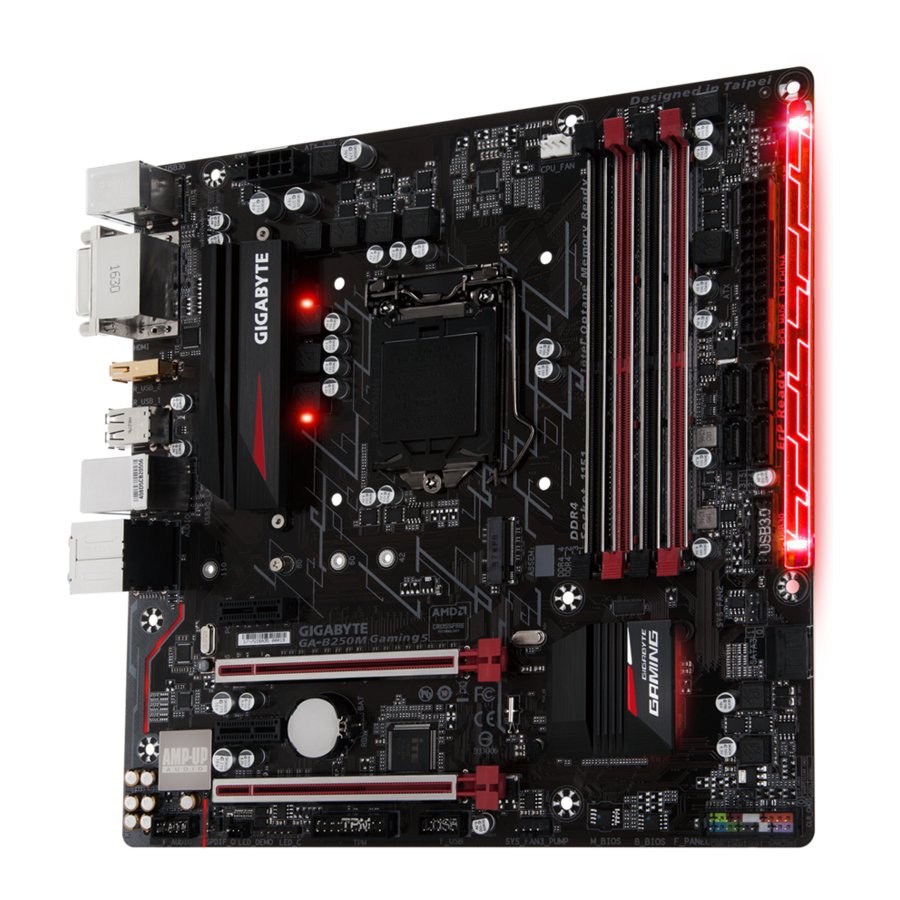
Motherboard Layout

Box Contents
- GA-B250M-Gaming motherboard
- Motherboard driver disk
- User's Manual
- Four SATA cables
- I/O Shield
* The box contents above are for reference only and the actual items shall depend on the product package you obtain.
The box contents are subject to change without notice.
Hardware Installation
Installation Precautions
The motherboard contains numerous delicate electronic circuits and components which can become damaged as a result of electrostatic discharge (ESD). Prior to installation, carefully read the user's manual and follow these procedures:
- Prior to installation, make sure the chassis is suitable for the motherboard.
- Prior to installation, do not remove or break motherboard S/N (Serial Number) sticker or warranty sticker provided by your dealer. These stickers are required for warranty validation.
- Always remove the AC power by unplugging the power cord from the power outlet before installing or removing the motherboard or other hardware components.
- When connecting hardware components to the internal connectors on the motherboard, make sure they are connected tightly and securely.
- When handling the motherboard, avoid touching any metal leads or connectors.
- It is best to wear an electrostatic discharge (ESD) wrist strap when handling electronic components such as a motherboard, CPU or memory. If you do not have an ESD wrist strap, keep your hands dry and first touch a metal object to eliminate static electricity.
- Prior to installing the motherboard, please have it on top of an antistatic pad or within an electrostatic shielding container.
- Before connecting or unplugging the power supply cable from the motherboard, make sure the power supply has been turned off.
- Before turning on the power, make sure the power supply voltage has been set according to the local voltage standard.
- Before using the product, please verify that all cables and power connectors of your hardware components are connected.
- To prevent damage to the motherboard, do not allow screws to come in contact with the motherboard circuit or its components.
- Make sure there are no leftover screws or metal components placed on the motherboard or within the computer casing.
- Do not place the computer system on an uneven surface.
- Do not place the computer system in a high-temperature or wet environment.
- Turning on the computer power during the installation process can lead to damage to system components as well as physical harm to the user.
- If you are uncertain about any installation steps or have a problem related to the use of the product, please consult a certified computer technician.
- If you use an adapter, extension power cable, or power strip, ensure to consult with its installation and/or grounding instructions.
Product Specifications
| CPU |
|
| Chipset |
|
| Memory |
|
| Onboard Graphics |
|
| Audio |
|
| LAN |
|
| Expansion Slots |
|
| Multi-Graphics Technology |
|
| Storage Interface |
|
| USB |
|
| Internal Connectors |
|
| Back Panel Connectors |
|
| I/O Controller |
|
| Hardware Monitor |
|
| BIOS |
|
| Unique Features |
|
| Bundled Software |
|
| Operating System |
|
| Form Factor |
|
* GIGABYTE reserves the right to make any changes to the product specifications and product-related information without prior notice.

Please visit GIGABYTE's website for support lists of CPU, memory modules, SSDs, and M.2 devices.

Please visit the Support\Utility List page on GIGABYTE's website to download the latest version of apps.
Installing the CPU

Read the following guidelines before you begin to install the CPU:
- Make sure that the motherboard supports the CPU. (Go to GIGABYTE's website for the latest CPU support list.)
- Always turn off the computer and unplug the power cord from the power outlet before installing the CPU to prevent hardware damage.
- Locate the pin one of the CPU. The CPU cannot be inserted if oriented incorrectly. (Or you may locate the notches on both sides of the CPU and alignment keys on the CPU socket.)
- Apply an even and thin layer of thermal grease on the surface of the CPU.
- Do not turn on the computer if the CPU cooler is not installed, otherwise overheating and damage of the CPU may occur.
- Set the CPU host frequency in accordance with the CPU specifications. It is not recommended that the system bus frequency be set beyond hardware specifications since it does not meet the standard requirements for the peripherals. If you wish to set the frequency beyond the standard specifications, please do so according to your hardware specifications including the CPU, graphics card, memory, hard drive, etc.
Installing the CPU
Locate the alignment keys on the motherboard CPU socket and the notches on the CPU.

Do not remove the CPU socket cover before inserting the CPU. It may pop off from the load plate automatically during the process of re-engaging the lever after you insert the CPU.

Please visit GIGABYTE's website for details on hardware installation.
Installing the Memory
Read the following guidelines before you begin to install the memory:
- Make sure that the motherboard supports the memory. It is recommended that memory of the same capacity, brand, speed, and chips be used. (Go to GIGABYTE's website for the latest supported memory speeds and memory modules.)
- Always turn off the computer and unplug the power cord from the power outlet before installing the memory to prevent hardware damage.
- Memory modules have a foolproof design. A memory module can be installed in only one direction. If you are unable to insert the memory, switch the direction.
Dual Channel Memory Configuration
This motherboard provides four memory sockets and supports Dual Channel Technology. After the memory is installed, the BIOS will automatically detect the specifications and capacity of the memory. Enabling Dual Channel memory mode will double the original memory bandwidth.
The four memory sockets are divided into two channels and each channel has two memory sockets as following:
 Channel A: DDR4_2, DDR4_4
Channel B: DDR4_1, DDR4_3
Dual Channel Memory Configurations Table
| DDR4_4 | DDR4_2 | DDR4_3 | DDR4_1 | |
| 2 Modules | - - | DS/SS | - - | DS/SS |
| DS/SS | - - | DS/SS | - - | |
| 4 Modules | DS/SS | DS/SS | DS/SS | DS/SS |
(SS=Single-Sided, DS=Double-Sided, "- -"=No Memory)
Due to CPU limitations, read the following guidelines before installing the memory in Dual Channel mode.
- Dual Channel mode cannot be enabled if only one memory module is installed.
- When enabling Dual Channel mode with two or four memory modules, it is recommended that memory of the same capacity, brand, speed, and chips be used.
Installing an Expansion Card
Read the following guidelines before you begin to install an expansion card:
- Make sure the motherboard supports the expansion card. Carefully read the manual that came with your expansion card.
- Always turn off the computer and unplug the power cord from the power outlet before installing an expansion card to prevent hardware damage.
Back Panel Connectors

- PS/2 Keyboard/Mouse Port
Use this port to connect a PS/2 mouse or keyboard. - USB 3.1 Gen 1 Port
The USB 3.1 Gen 1 port supports the USB 3.1 Gen 1 specification and is compatible to the USB 2.0 specification. You can connect a USB DAC to this port or use this port for USB devices. - DVI-D Port (Note)
The DVI-D port conforms to the DVI-D specification and supports a maximum resolution of 1920x1200@60 Hz (the actual resolutions supported depend on the monitor being used). Connect a monitor that supports DVI-D connection to this port. - HDMI Port
The HDMI port is HDCP compliant and supports Dolby TrueHD and DTS HD Master Audio formats. It also supports up to 192KHz/16bit 8-channel LPCM audio output. You can use this port to connect your HDMI-supported monitor. The maximum supported resolution is 4096x2160@24 Hz, but the actual resolutions supported are dependent on the monitor being used.
![]()
After installing the HDMI device, make sure to set the default sound playback device to HDMI. (The item name may differ depending on your operating system.) - USB 2.0/1.1 Port
The USB port supports the USB 2.0/1.1 specification. Use this port for USB devices. You can connect a USB DAC to this port or use this port for USB devices. - USB 2.0/1.1 Port
The USB port supports the USB 2.0/1.1 specification. Use this port for USB devices. - RJ-45 LAN Port
The Gigabit Ethernet LAN port provides Internet connection at up to 1 Gbps data rate. The following describes the states of the LAN port LEDs.
![]()
Connection/Speed LED:
Activity LED:State Description Orange 1 Gbps data rate Green 100 Mbps data rate Off 10 Mbps data rate State Description Blinking Data transmission or receiving is occurring On No data transmission or receiving is occurring - USB 3.1 Gen 1 Port
The USB 3.1 Gen 1 port supports the USB 3.1 Gen 1 specification and is compatible to the USB 2.0 specification. Use this port for USB devices.


(Note) The DVI-D port does not support D-Sub connection by adapter.
- Center/Subwoofer Speaker Out
Use this audio jack to connect centre/subwoofer speakers in a 5.1/7.1-channel audio configuration. - Rear Speaker Out
This jack can be used to connect rear speakers in a 4/5.1/7.1-channel audio configuration. - Optical S/PDIF Out Connector
This connector provides digital audio out to an external audio system that supports digital optical audio. Before using this feature, ensure that your audio system provides an optical digital audio in connector. - Line In
The line in jack. Use this audio jack for line in devices such as an optical drive, walkman, etc. - Line Out
Use this audio jack for a headphone or 2-channel speaker. This jack can be used to connect front speakers in a 4/5.1/7.1-channel audio configuration. - Mic In
The Mic in jack.

If you want to install a Side Speaker, you need to retask either the Line in or Mic in jack to be Side Speaker out through the audio driver. Please visit GIGABYTE's website for more software information.
![warning]()
When removing the cable connected to a back panel connector, first remove the cable from your device and then remove it from the motherboard.- When removing the cable, pull it straight out from the connector. Do not rock it side to side to prevent an electrical short inside the cable connector.
Internal Connectors

- ATX_12V_2X4
- ATX
- CPU_FAN
- SYS_FAN1/2
- SYS_FAN3_PUMP
- SATA3 0/1/2/3/4/5
- BAT
- SPDIF_O
- M2Q_32G
- F_PANEL
- F_AUDIO
- F_USB30
- F_USB
- TPM
- CLR_CMOS
- LED_C
Read the following guidelines before connecting external devices:
- First make sure your devices are compliant with the connectors you wish to connect.
- Before installing the devices, be sure to turn off the devices and your computer. Unplug the power cord from the power outlet to prevent damage to the devices.
- After installing the device and before turning on the computer, make sure the device cable has been securely attached to the connector on the motherboard.
ATX_12V_2X4/ATX (2x4 12V Power Connector and 2x12 Main Power Connector)
With the use of the power connector, the power supply can supply enough stable power to all the components on the motherboard. Before connecting the power connector, first make sure the power supply is turned off and all devices are properly installed. The power connector possesses a foolproof design. Connect the power supply cable to the power connector in the correct orientation. The 12V power connector mainly supplies power to the CPU. If the 12V power connector is not connected, the computer will not start.

To meet expansion requirements, it is recommended that a power supply that can withstand high power consumption be used (500W or greater). If a power supply is used that does not provide the required power, the result can lead to an unstable or unbootable system.
ATX_12V_2X4:

| Pin No. | Definition | Pin No. | Definition |
| 1 | GND (Only for 2x4-pin 12V) | 5 | +12V (Only for 2x4-pin 12V) |
| 2 | GND (Only for 2x4-pin 12V) | 6 | +12V (Only for 2x4-pin 12V) |
| 3 | GND | 7 | +12V |
| 4 | GND | 8 | +12V |
ATX:

| Pin No. | Definition | Pin No. | Definition |
| 1 | 3.3V | 13 | 3.3V |
| 2 | 3.3V | 14 | -12V |
| 3 | GND | 15 | GND |
| 4 | +5V | 16 | PS_ON (soft On/Off) |
| 5 | GND | 17 | GND |
| 6 | +5V | 18 | GND |
| 7 | GND | 19 | GND |
| 8 | Power Good | 20 | NC |
| 9 | 5VSB (stand by +5V) | 21 | +5V |
| 10 | +12V | 22 | +5V |
| 11 | +12V (Only for 2x12-pin ATX) | 23 | +5V (Only for 2x12-pin ATX) |
| 12 | 3.3V (Only for 2x12-pin ATX) | 24 | GND (Only for 2x12-pin ATX) |
CPU_FAN/SYS_FAN1/2 (Fan Headers)
All fan headers on this motherboard are 4-pin. Most fan headers possess a foolproof insertion design. When connecting a fan cable, be sure to connect it in the correct orientation (the black connector wire is the ground wire). The speed control function requires the use of a fan with fan speed control design. For optimum heat dissipation, it is recommended that a system fan be installed inside the chassis.

CPU_FAN/SYS_FAN1
 SYS_FAN2
| Pin No. | Definition |
| 1 | GND |
| 2 | Voltage Speed Control |
| 3 | Sense |
| 4 | PWM Speed Control |
![warning]()
Be sure to connect fan cables to the fan headers to prevent your CPU and system from overheating. Overheating may result in damage to the CPU or the system may hang.- These fan headers are not configuration jumper blocks. Do not place a jumper cap on the headers.
SYS_FAN3_PUMP (System Fan/Water Cooling Pump Header)
The fan/pump header is 4-pin and possesses a foolproof insertion design. Most fan headers possess a foolproof insertion design. When connecting a fan cable, be sure to connect it in the correct orientation (the black connector wire is the ground wire). The speed control function requires the use of a fan with fan speed control design. For optimum heat dissipation, it is recommended that a system fan be installed inside the chassis. The header also provides speed control for a water cooling pump, refer to Chapter "BIOS Setup," "M.I.T.," for more information

| Pin No. | Definition |
| 1 | GND |
| 2 | Voltage Speed Control |
| 3 | Sense |
| 4 | PWM Speed Control |
SATA3 0/1/2/3/4/5 (SATA 6Gb/s Connectors)
The SATA connectors conform to SATA 6Gb/s standard and are compatible with SATA 3Gb/s and SATA 1.5Gb/s standard. Each SATA connector supports a single SATA device.

| Pin No. | Definition |
| 1 | GND |
| 2 | TXP |
| 3 | TXN |
| 4 | GND |
| 5 | RXN |
| 6 | RXP |
| 7 | GND |

To enable hot-plugging for the SATA ports, refer to Chapter "BIOS Setup," "Peripherals\SATA And RST Configuration," for more information.
BAT (Battery)
The battery provides power to keep the values (such as BIOS configurations, date, and time information) in the CMOS when the computer is turned off. Replace the battery when the battery voltage drops to a low level, or the CMOS values may not be accurate or may be lost.

You may clear the CMOS values by removing the battery:
- Turn off your computer and unplug the power cord.
- Gently remove the battery from the battery holder and wait for one minute. (Or use a metal object like a screwdriver to touch the positive and negative terminals of the battery holder, making them short for 5 seconds.)
- Replace the battery.
- Plug in the power cord and restart your computer.
![warning]()
Always turn off your computer and unplug the power cord before replacing the battery.- Replace the battery with an equivalent one. Danger of explosion if the battery is replaced with an incorrect model.
- Contact the place of purchase or local dealer if you are not able to replace the battery by yourself or uncertain about the battery model.
- When installing the battery, note the orientation of the positive side (+) and the negative side (-) of the battery (the positive side should face up).
- Used batteries must be handled in accordance with local environmental regulations.
SPDIF_O (S/PDIF Out Header)
This header supports digital S/PDIF Out and connects a S/PDIF digital audio cable (provided by expansion cards) for digital audio output from your motherboard to certain expansion cards like graphics cards and sound cards. For example, some graphics cards may require you to use a S/PDIF digital audio cable for digital audio output from your motherboard to your graphics card if you wish to connect an HDMI display to the graphics card and have digital audio output from the HDMI display at the same time. For information about connecting the S/PDIF digital audio cable, carefully read the manual for your expansion card.

| Pin No. | Definition |
| 1 | SPDIFO |
| 2 | GND |
M2Q_32G (M.2 Socket 3 Connector)
The M.2 connector supports M.2 SATA SSDs and M.2 PCIe SSDs.

Follow the steps below to correctly install an M.2 SSD in the M.2 connector.
Step 1:
Use a screw driver to unfasten the screw and nut from the motherboard. Locate the proper mounting hole for the M.2 SSD to be installed and then screw the nut first.
Step 2:
Slide the M.2 SSD into the connector at an angle.
Step 3:
Press the M.2 SSD down and then secure it with the screw.

Select the proper hole for the M.2 SSD to be installed and refasten the screw and nut.
Installation Notices for the M2Q_32G and SATA Connectors:
Due to the limited number of lanes provided by the Chipset, the availability of the SATA connectors may be affected by the type of device installed in the M2Q_32G connector. The M2Q_32G connector shares bandwidth with the SATA3 5 connector. Refer to the following table for details.
| Type of M.2 SSD/Connector | SATA3 0 | SATA3 1 | SATA3 2 | SATA3 3 | SATA3 4 | SATA3 5 |
| M.2 SATA SSD |  | | | | |  |
| M.2 PCIe x4 SSD | | | | | | |
| M.2 PCIe x2 SSD | | | | | | |
| No M.2 SSD Installed | | | | | | |
: Available,
: Not available
F_PANEL (Front Panel Header)
Connect the power switch, reset switch, speaker, chassis intrusion switch/sensor and system status indicator on the chassis to this header according to the pin assignments below. Note the positive and negative pins before connecting the cables.

- PLED/PWR_LED (Power LED, Yellow/Purple):
Connects to the power status indicator on the chassis front panel. The LED is on when the system is operating. The LED is off when the system is in S3/S4 sleep state or powered off (S5).
| System Status | LED |
| S0 | On |
| S3/S4/S5 | Off |
- PW (Power Switch, Red):
Connects to the power switch on the chassis front panel. You may configure the way to turn off your system using the power switch (refer to Chapter "BIOS Setup," "Power," for more information). - SPEAK (Speaker, Orange):
Connects to the speaker on the chassis front panel. The system reports system startup status by issuing a beep code. One single short beep will be heard if no problem is detected at system startup. - HD (Hard Drive Activity LED, Blue):
Connects to the hard drive activity LED on the chassis front panel. The LED is on when the hard drive is reading or writing data. - RES (Reset Switch, Green):
Connects to the reset switch on the chassis front panel. Press the reset switch to restart the computer if the computer freezes and fails to perform a normal restart. - CI (Chassis Intrusion Header, Gray):
Connects to the chassis intrusion switch/sensor on the chassis that can detect if the chassis cover has been removed. This function requires a chassis with a chassis intrusion switch/sensor. - NC (Orange): No Connection.
The front panel design may differ by chassis. A front panel module mainly consists of power switch, reset switch, power LED, hard drive activity LED, speaker and etc. When connecting your chassis front panel module to this header, make sure the wire assignments and the pin assignments are matched correctly.
F_AUDIO (Front Panel Audio Header)
The front panel audio header supports Intel High Definition audio (HD) and AC'97 audio. You may connect your chassis front panel audio module to this header. Make sure the wire assignments of the module connector match the pin assignments of the motherboard header. Incorrect connection between the module connector and the motherboard header will make the device unable to work or even damage it.

For HD Front Panel Audio:
| Pin No. | Definition |
| 1 | MIC2_L |
| 2 | GND |
| 3 | MIC2_R |
| 4 | NC |
| 5 | LINE2_R |
| 6 | Sense |
| 7 | FAUDIO_JD |
| 8 | No Pin |
| 9 | LINE2_L |
| 10 | Sense |
For AC'97 Front Panel Audio:
| Pin No. | Definition |
| 1 | MIC |
| 2 | GND |
| 3 | MIC Power F_ |
| 4 | NC |
| 5 | Line Out (R) |
| 6 | NC |
| 7 | NC |
| 8 | No Pin |
| 9 | Line Out (L) |
| 10 | NC |
![]()
The front panel audio header supports HD audio by default.- Audio signals will be present on both of the front and back panel audio connections simultaneously.
- Some chassis provide a front panel audio module that has separated connectors on each wire instead of a single plug. For information about connecting the front panel audio module that has different wire assignments, please contact the chassis manufacturer.

F_USB30 (USB 3.1 Gen 1 Header)
The header conforms to USB 3.1 Gen 1 and USB 2.0 specification and can provide two USB ports. For purchasing the optional 3.5" front panel that provides two USB 3.1 Gen 1 ports, please contact the local dealer.

| Pin No. | Definition | Pin No. | Definition |
| 1 | VBUS | 11 | D2+ |
| 2 | SSRX1- | 12 | D2- |
| 3 | SSRX1+ | 13 | GND |
| 4 | GND | 14 | SSTX2+ |
| 5 | SSTX1- | 15 B S S | SSTX2- |
| 6 | SSTX1+ | 16 | GND 1 |
| 7 | GND | 17 | SSRX2+ |
| 8 | D1- | 18 | SSRX2- |
| 9 | D1+ | 19 | VBUS |
| 10 | NC | 20 | No Pin |
F_USB (USB 2.0/1.1 Header)
The header conforms to USB 2.0/1.1 specification. Each USB header can provide two USB ports via an optional USB bracket. For purchasing the optional USB bracket, please contact the local dealer.

| Pin No. | Definition | Pin No. | Definition |
| 1 | Power (5V) | 6 | USB DY+ |
| 2 | Power (5V) | 7 | GND |
| 3 | USB DX- | 8 | GND |
| 4 | USB DY- | 9 | No Pin |
| 5 | USB DX+ | 10 | NC |
![warning]()
Do not plug the IEEE 1394 bracket (2x5-pin) cable into the USB 2.0/1.1 header.- Prior to installing the USB bracket, be sure to turn off your computer and unplug the power cord from the power outlet to prevent damage to the USB bracket.
TPM (Trusted Platform Module Header)
You may connect a TPM (Trusted Platform Module) to this header.

| Pin No. | Definition | Pin No. | Definition |
| 1 | LCLK | 11 | LAD0 |
| 2 | GND | 12 | GND |
| 3 | LFRAME | 13 | NC |
| 4 | No Pin | 14 | NC |
| 5 | LRESET | 15 | SB3V |
| 6 | NC | 16 | SERIRQ |
| 7 | LAD3 | 17 | GND |
| 8 | LAD2 | 18 | NC |
| 9 | VCC3 | 19 | NC |
| 10 | LAD1 | 20 | NC |
CLR_CMOS (Clear CMOS Jumper)
Use this jumper to clear the BIOS configuration and reset the CMOS values to factory defaults. To clear the CMOS values, use a metal object like a screwdriver to touch the two pins for a few seconds.

Open: Normal

Short: Clear CMOS Values
![warning]()
Always turn off your computer and unplug the power cord from the power outlet before clearing the CMOS values.- After system restart, go to BIOS Setup to load factory defaults (select Load Optimised Defaults) or manually configure the BIOS settings (refer to Chapter "BIOS Setup," for BIOS configurations).
LED_C (RGB (RGBW) LED Strip Extension Cable Header)
The header can be used to connect a standard 5050 RGB (RGBW) LED strip (12V/G/R/B/W), with maximum power rating of 2A (12V) and maximum length of 2m.

| Pin No. | Definition |
| 1 | 12V |
| 2 | G |
| 3 | R |
| 4 | B |
| 5 | W |
Connect one end of the RGB (RGBW) LED strip extension cable to the header and the other end to your RGB (RGBW) LED strip. The black wire (marked with a triangle on the plug) of the extension cable must be connected to Pin 1 (12V) of this header. The 12V pin (marked with an arrow) on the other end of the extension cable must be lined up with the 12V of the LED strip. Be careful with the connection orientation of the LED strip; incorrect connection may lead to the damage of the LED strip.

For how to turn on/off the lights of the RGB (RGBW) LED strip, refer to the instructions on in Chapter "BIOS Setup."
Before installing the devices, be sure to turn off the devices and your computer. Unplug the power cord from the power outlet to prevent damage to the devices.
BIOS Setup
BIOS (Basic Input and Output System) records hardware parameters of the system in the CMOS on the motherboard. Its major functions include conducting the Power-On Self-Test (POST) during system startup, saving system parameters and loading operating system, etc. BIOS includes a BIOS Setup program that allows the user to modify basic system configuration settings or to activate certain system features.
When the power is turned off, the battery on the motherboard supplies the necessary power to the CMOS to keep the configuration values in the CMOS. To access the BIOS Setup program, press the <Delete> key during the POST when the power is turned on. To upgrade the BIOS, use either the GIGABYTE Q-Flash or BIOS utility.
- Q-Flash allows the user to quickly and easily upgrade or back up BIOS without entering the operating system.
- BIOS is a Windows-based utility that searches and downloads the latest version of BIOS from the Internet and updates the BIOS.
![warning]()
Because BIOS flashing is potentially risky, if you do not encounter problems using the current version of BIOS, it is recommended that you not flash the BIOS. To flash the BIOS, do it with caution. Inadequate BIOS flashing may result in system malfunction.- It is recommended that you not alter the default settings (unless you need to) to prevent system instability or other unexpected results. Inadequately altering the settings may result in system's failure to boot. If this occurs, try to clear the CMOS values and reset the board to default values. (Refer to the "Load Optimised Defaults" section in this chapter or introductions of the battery/clear CMOS jumper in Hardware Installation Chapter for how to clear the CMOS values.)
Startup Screen
The following startup Logo screen will appear when the computer boots. (Sample BIOS Version: D3)

There are two different BIOS modes as follows and you can use the <F2> key to switch between the two modes. The Classic Setup mode provides detailed BIOS settings. You can press the arrow keys on your keyboard to move among the items and press <Enter> to accept or enter a sub-menu. Or you can use your mouse to select the item you want. Easy Mode allows users to quickly view their current system information or to make adjustments for optimum performance. In Easy Mode, you can use your mouse to move through configuration items.
![]()
When the system is not stable as usual, select the Load Optimized Defaults item to set your system to its defaults.- The BIOS Setup menus described in this chapter are for reference only and may differ by BIOS version.

M.I.T.

Whether the system will work stably with the overclock/overvoltage settings you made is dependent on your overall system configurations. Incorrectly doing overclock/overvoltage may result in damage to CPU, chipset, or memory and reduce the useful life of these components. This page is for advanced users only and we recommend you not to alter the default settings to prevent system instability or other unexpected results. (Inadequately altering the settings may result in system's failure to boot. If this occurs, clear the CMOS values and reset the board to default values.)
- Advanced Frequency Settings
- Host Clock Value
Displays the current operating Host Clock frequency. - Graphics Slice Ratio (Note)
Allows you to set the Graphics Slice Ratio. - Graphics UnSlice Ratio (Note)
Allows you to set the Graphics UnSlice Ratio. - CPU Clock Ratio
Allows you to alter the clock ratio for the installed CPU. The adjustable range is dependent on the CPU being installed. - CPU Frequency
Displays the current operating CPU frequency.
- Host Clock Value
- Advanced CPU Core Settings
- CPU Clock Ratio, CPU Frequency
The settings above are synchronous to those under the same items on the Advanced Frequency Settings menu. - AVX Offset (Note)
AVX offset is the negative offset of AVX ratio.
- CPU Clock Ratio, CPU Frequency
(Note) This item is present only when you install a CPU that supports this feature. For more information about Intel® CPUs' unique features, please visit Intel's website.
- Uncore Ratio
Allows you to set the CPU Uncore ratio. The adjustable range is dependent on the CPU being used. - Uncore Frequency
Displays the current CPU Uncore frequency. - CPU Flex Ratio Override
Enables or disables the CPU Flex Ratio. The maximum CPU clock ratio will be based on the CPU Flex Ratio Settings value if CPU Clock Ratio is set to Auto. (Default: Disabled) - CPU Flex Ratio Settings
Allows you to set the CPU Flex Ratio. The adjustable range may vary by CPU. - Intel(R) Turbo Boost Technology (Note)
Allows you to determine whether to enable the Intel ® CPU Turbo Boost technology. Auto lets the BIOS automatically configure this setting. (Default: Auto) - Turbo Ratio (Note)
Allows you to set the CPU Turbo ratios for different number of active cores. Auto sets the CPU Turbo ratios according to the CPU specifications. (Default: Auto) - Power Limit TDP (Watts) / Power Limit Time
Allows you to set the power limit for CPU Turbo mode and how long it takes to operate at the specified power limit. If the specified value is exceeded, the CPU will automatically reduce the core frequency in order to reduce the power. Auto sets the power limit according to the CPU specifications. (Default: Auto) - Core Current Limit (Amps)
Allows you to set a current limit for CPU Turbo mode. When the CPU current exceeds the specified current limit, the CPU will automatically reduce the core frequency in order to reduce the current. Auto sets the power limit according to the CPU specifications. (Default: Auto) - No. of CPU Cores Enabled (Note)
Allows you to select the number of CPU cores to enable in an Intel ® multi-core CPU (the number of CPU cores may vary by CPU). Auto lets the BIOS automatically configure this setting. (Default: Auto) - Hyper-Threading Technology (Note)
Allows you to determine whether to enable multi-threading technology when using an Intel supports this function. This feature only works for operating systems that support multi-processor mode. Auto lets the BIOS automatically configure this setting. (Default: Auto) - Intel(R) Speed Shift Technology (Intel® Speed Shift Technology) (Note)
Enables or disables Intel® Speed Shift Technology. Enabling this feature allows the processor to ramp up its operating frequency more quickly and then improves the system responsiveness. (Default: Disabled) - CPU Enhanced Halt (C1E) (Note)
Enables or disables Intel ® CPU Enhanced Halt (C1E) function, a CPU power-saving function in system halt state. When enabled, the CPU core frequency and voltage will be reduced during system halt state to decrease power consumption. Auto lets the BIOS automatically configure this setting. (Default: Auto) - C3 State Support (Note)
Allows you to determine whether to let the CPU enter C3 mode in system halt state. When enabled, the CPU core frequency and voltage will be reduced during system halt state to decrease power consumption. The C3 state is a more enhanced power-saving state than C1. Auto lets the BIOS automatically configure this setting. (Default: Auto)
(Note) This item is present only when you install a CPU that supports this feature. For more information about Intel® CPUs' unique features, please visit Intel's website.
- C6/C7 State Support (Note 1)
Allows you to determine whether to let the CPU enter C6/C7 mode in system halt state. When enabled, the CPU core frequency and voltage will be reduced during system halt state to decrease power consumption. The C6/C7 state is a more enhanced power-saving state than C3. Auto lets the BIOS automatically configure this setting. (Default: Auto) - C8 State Support (Note 1)
Allows you to determine whether to let the CPU enter C8 mode in system halt state. When enabled, the CPU core frequency and voltage will be reduced during system halt state to decrease power consumption. The C8 state is a more enhanced power-saving state than C6/C7. Auto lets the BIOS automatically configure this setting. (Default: Auto) - Package C State Limit (Note 1)
Allows you to specify the C-state limit for the processor. Auto lets the BIOS automatically configure this setting. (Default: Auto) - CPU Thermal Monitor (Note 1)
Enables or disables Intel ® Thermal Monitor function, a CPU overheating protection function. When enabled, the CPU core frequency and voltage will be reduced when the CPU is overheated. Auto lets the BIOS automatically configure this setting. (Default: Auto) - CPU EIST Function (Note 1)
Enables or disables Enhanced Intel ® Speed Step Technology (EIST). Depending on CPU loading, Intel EIST technology can dynamically and effectively lower the CPU voltage and core frequency to decrease average power consumption and heat production. Auto lets the BIOS automatically configure this setting. (Default: Auto) - Voltage Optimisation
Allows you to determine whether to enable voltage optimization to reduce power consumption. (Default: Disabled) - RSR
Allows you to determine whether to automatically lower the CPU turbo ratio if the CPU voltage/temperature is too high. (Default: Enabled) - Hardware Prefetcher
Allows you to determine whether to enable hardware prefetcher to prefetch data and instructions from the memory into the cache. (Default: Enabled) - Adjacent Cache Line Prefetch
Allows you to determine whether to enable the adjacent cache line prefetch mechanism that lets the processor retrieve the requested cache line as well as the subsequent cache line. (Default: Enabled) - Extreme Memory Profile (X.M.P.) (Note 2)
Allows the BIOS to read the SPD data on XMP memory module(s) to enhance memory performance when enabled.![]() Disabled
DisabledDisables this function. (Default) ![]() Profile1
Profile1 Uses Profile 1 settings. ![]() Profile2 (Note 2)
Profile2 (Note 2)Uses Profile 2 settings.

- System Memory Multiplier
Allows you to set the system memory multiplier. Auto sets memory multiplier according to memory SPD data. (Default: Auto)
(Note 1) This item is present only when you install a CPU that supports this feature. For more information about Intel® CPUs' unique features, please visit Intel's website.
(Note 2) This item is present only when you install a CPU and a memory module that support this feature.
- Memory Odd Ratio (100/133 or 200/266)
Allows you to manually adjust the memory reference clock. (Default: Auto) - Memory Frequency (MHz)
- The first memory frequency value is the normal operating frequency of the memory being used; the second is the memory frequency that is automatically adjusted according to the System Memory Multiplier settings.
- Advanced Memory Settings
- Extreme Memory Profile (X.M.P.) (Note) , System Memory Multiplier, Memory Odd Ratio(100/133 or 200/266), Memory Frequency(MHz)
The settings above are synchronous to those under the same items on the Advanced Frequency Settings menu. - Memory Boot Mode (Note)
Provides memory detection and training methods.![]() Auto
Auto Lets the BIOS automatically configure this setting. (Default) ![]() Normal
NormalThe BIOS automatically performs memory training. Please note that if the system becomes unstable or unbootable, try to clear the CMOS values and reset the board to default values. (Refer to the introductions of the battery/clear CMOS jumper in Hardware Installation Chapter for how to clear the CMOS values.) ![]() Enable Fast Boot
Enable Fast Boot S kip memory detection and training in some specific criteria for faster memory boot. ![]() Disable Fast Boot
Disable Fast BootDetect and train memory at every single boot. - Memory Enhancement Settings
Provides several memory performance enhancement settings: Normal (basic performance), Relax OC, Enhanced Stability, and Enhanced Performance. (Default: Normal) - Memory Timing Mode
Manual and Advanced Manual allows the Memory Multiplier Tweaker, Channel Interleaving, Rank Interleaving, and memory timing settings below to be configurable. Options are: Auto (default), Manual, Advanced Manual. - Profile DDR Voltage
When using a non-XMP memory module or Extreme Memory Profile (X.M.P.) is set to Disabled, the value is displayed according to your memory specification. When Extreme Memory Profile (X.M.P.) is set to Profile1 or Profile2, the value is displayed according to the SPD data on the XMP memory. - Memory Multiplier Tweaker
Provides different levels of memory auto-tuning. (Default: Auto) - Channel Interleaving
Enables or disables memory channel interleaving. Enabled allows the system to simultaneously access different channels of the memory to increase memory performance and stability. Auto lets the BIOS automatically configure this setting. (Default: Auto) - Rank Interleaving
Enables or disables memory rank interleaving. Enabled allows the system to simultaneously access different ranks of the memory to increase memory performance and stability. Auto lets the B IOS automatically configure this setting. (Default: Auto)
- Extreme Memory Profile (X.M.P.) (Note) , System Memory Multiplier, Memory Odd Ratio(100/133 or 200/266), Memory Frequency(MHz)
(Note) This item is present only when you install a CPU and a memory module that support this feature.
- Channel A/B Memory Sub Timings
This sub-menu provides memory timing settings for each channel of memory. The respective timing setting screens are configurable only when Memory Timing Mode is set to Manual or Advanced Manual. Note: Your system may become unstable or fail to boot after you make changes on the memory timings. If this occurs, please reset the board to default values by loading optimised defaults or clearing the CMOS values. - Advanced Voltage Settings
- Advanced Power Settings
- CPU Vcore Loadline Calibration
Allows you to configure Load-Line Calibration for the CPU Vcore voltage. Selecting a higher level keeps the CPU Vcore voltage more consistent with what is set in BIOS under heavy load. Auto lets the BIOS automatically configure this setting and sets the voltage following Intel's specifications. (Default: Auto) - VAXG Loadline Calibration
Allows you to configure Load-Line Calibration for the CPU VAXG voltage. Selecting a higher level keeps the CPU VAXG voltage more consistent with what is set in BIOS under heavy load. Auto lets the BIOS automatically configure this setting and sets the voltage following Intel's specifications. (Default: Auto)
- CPU Vcore Loadline Calibration
- CPU Core Voltage Control
This section provides CPU voltage control options. - Chipset Voltage Control
This section provides Chipset voltage control options. - DRAM Voltage Control
This section provides memory voltage control options. - PC Health Status
- Reset Case Open Status
![]() Disabled
DisabledKeeps or clears the record of previous chassis intrusion status. (Default) ![]() Enabled
EnabledClears the record of previous chassis intrusion status and the Case Open field will show "No" at next boot. - Case Open
Displays the detection status of the chassis intrusion detection device attached to the motherboard CI header. If the system chassis cover is removed, this field will show "Yes", otherwise it will show "No". To clear the chassis intrusion status record, set Reset Case Open Status to Enabled, save the settings to the CMOS, and then restart your system. - CPU Vcore/CPU VCCSA/DRAM Channel A/B Voltage/+3.3V/+5V/+12V/CPU VAXG
Displays the current system voltages.
- Reset Case Open Status
- Miscellaneous Settings
- Max Link Speed
Allows you to set the operation mode of the PCI Express slots to Gen 1, Gen 2, or Gen 3. Actual operation mode is subject to the hardware specification of each slot. Auto lets the BIOS automatically configure this setting. (Default: Auto) - 3DMark01 Enhancement
Allows you to determine whether to enhance some legacy benchmark performance. (Default: Disabled)
- Max Link Speed
- Smart Fan 5 Settings & Monitor
Allows you to select a target to monitor and to make further adjustment. (Default: CPU FAN)- Fan Speed Control
![]() Normal
NormalAllows the fan to run at different speeds according to the temperature. You can adjust the fan speed with System Information Viewer based on your system requirements. (Default) ![]() Silent
SilentAllows the fan to run at slow speeds. ![]() Manual
ManualAllows you to control the fan speed in the curve graph. ![]() Full Speed
Full SpeedAllows the fan to run at full speeds. - Fan Control Use Temperature Input
Allows you to select the reference temperature for fan speed control. - Temperature Interval
Allows you to select the temperature interval for fan speed change. - Fan/Pump Control Mode
![]() Auto
AutoLets the BIOS automatically detect the type of fan/pump installed and sets the optimal control mode. (Default) ![]() Voltage
VoltageVoltage mode is recommended for a 3-pin fan/pump. ![]() PWM
PWMPWM mode is recommended for a 4-pin fan/pump. - Fan Speed
Displays current fan/pump speeds. - Temperature Warning Control
Sets the warning threshold for temperature. When temperature exceeds the threshold, BIOS will emit warning sound. Options are: Disabled (default), 60oC/140oF, 70oC/158oF, 80oC/176oF, 90oC/194oF. - Fan/Pump Fail Warning
Allows the system to emit warning sound if the fan/pump is not connected or fails. Check the fan/pump condition or fan/pump connection when this occurs. (Default: Disabled)
- Fan Speed Control
System

This section provides information on your motherboard model and BIOS version. You can also select the default language used by the BIOS and manually set the system time.
- Access Level
Displays the current access level depending on the type of password protection used. (If no password is set, the default will display as Administrator.) The Administrator level allows you to make changes to all
BIOS settings; the User level only allows you to make changes to certain BIOS settings but not all. - System Language
Selects the default language used by the BIOS. - System Date
Sets the system date. The date format is week (read-only), month, date, and year. Use <Enter> to switch between the Month, Date, and Year fields and use the <Page Up> or <Page Down> key to set the desired value. - System Time
Sets the system time. The time format is hour, minute, and second. For example, 1 p.m. is 13:00:00. Use <Enter> to switch between the Hour, Minute, and Second fields and use the <Page Up> or <Page Down> key to set the desired value.
BIOS

- Bootup NumLock State
Enables or disables Numlock feature on the numeric keypad of the keyboard after the POST. (Default: On) - Security Option
Specifies whether a password is required every time the system boots, or only when you enter BIOS Setup. After configuring this item, set the password(s) under the Administrator Password/User Password item.![]() Setup
SetupA password is only required for entering the BIOS Setup program. A password is required for booting the system and for entering the BIOS Setup ![]() System
SystemA password is required for booting the system and for entering the BIOS Setup program. (Default) - Full Screen LOGO Show
Allows you to determine whether to display the GIGABYTE Logo at system startup. Disabled skips the GIGABYTE Logo when the system starts up. (Default: Enabled) - Boot Option Priorities
Specifies the overall boot order from the available devices. Removable storage devices that support GPT format will be prefixed with "UEFI:" string on the boot device list. To boot from an operating system that supports GPT partitioning, select the device prefixed with "UEFI:" string. Or if you want to install an operating system that supports GPT partitioning such as Windows 7 64-bit, select the optical drive that contains the Windows 7 64-bit installation disk and is prefixed with "UEFI:" string. - Hard Drive/CD/DVD ROM Drive/Floppy Drive/Network Device BBS Priorities
Specifies the boot order for a specific device type, such as hard drives, optical drives, floppy disk drives, and devices that support Boot from LAN function, etc. Press <Enter> on this item to enter the submenu that presents the devices of the same type that are connected. This item is present only if at least one device for this type is installed. - Fast Boot
Enables or disables Fast Boot to shorten the OS boot process. Ultra Fast provides the fastest bootup speed. (Default: Disabled) - SATA Support
This item is configurable only when Fast Boot is set to Enabled or Ultra Fast.![]() All Sata Devices
All Sata DevicesAll SATA devices are functional in the operating system and during the POST. (Default) ![]() Last Boot HDD Only
Last Boot HDD Only Except for the previous boot drive, all SATA devices are disabled before the OS boot process completes. - VGA Support
Allows you to select which type of operating system to boot.
This item is configurable only when Fast Boot is set to Enabled or Ultra Fast.![]() Auto
AutoEnables legacy option ROM only. ![]() EFI Driver
EFI DriverEnables EFI option ROM. (Default) - USB Support
This item is configurable only when Fast Boot is set to Enabled. This function is disabled when Fast Boot is set to Ultra Fast.![]() Disabled
DisabledAll USB devices are disabled before the OS boot process completes. ![]() Full Initial
Full InitialAll USB devices are functional in the operating system and during the POST. ![]() Partial Initial
Partial InitialPart of the USB devices are disabled before the OS boot process completes. (Default) - PS2 Devices Support
This item is configurable only when Fast Boot is set to Enabled. This function is disabled when Fast Boot is set to Ultra Fast.![]() Disabled
DisabledAll PS/2 devices are disabled before the OS boot process completes. ![]() Enabled
EnabledAll PS/2 devices are functional in the operating system and during the POST. (Default)
- NetWork Stack Driver Support
This item is configurable only when Fast Boot is set to Enabled or Ultra Fast.![]() Disabled
DisabledDisables booting from the network. (Default) ![]() Enabled
EnabledEnables booting from the network. - Next Boot After AC Power Loss
This item is configurable only when Fast Boot is set to Enabled or Ultra Fast.![]() Normal Boot
Normal BootEnables normal bootup upon the return of the AC power. (Default) ![]() Fast Boot
Fast BootKeeps the Fast Boot settings upon the return of the AC power. - Mouse Speed
Allows you to set the mouse cursor movement speed. (Default: 1 X) - Windows 8/10 Features
Allows you to select the operating system to be installed. (Default: Other OS) - CSM Support
Enables or disables UEFI CSM (Compatibility Support Module) to support a legacy PC boot process.
This item is configurable only when Windows 8/10 Features is set to Windows 8/10 or Windows 8/10 WHQL.![]() Enabled
EnabledEnables UEFI CSM. (Default) ![]() Disabled
DisabledDisables UEFI CSM and supports UEFI BIOS boot process only. - LAN PXE Boot Option ROM
Allows you to select whether to enable the legacy option ROM for the LAN controller. (Default: Disabled) This item is configurable only when CSM Support is set to Enabled. - Storage Boot Option Control
Allows you to select whether to enable the UEFI or legacy option ROM for the storage device controller.
This item is configurable only when CSM Support is set to Enabled.![]() Do not launch
Do not launchDisables option ROM. ![]() Legacy
LegacyEnables legacy option ROM only. (Default) ![]() UEFI
UEFIEnables UEFI option ROM only. - Other PCI Device
Allows you to select whether to enable the UEFI or Legacy option ROM for the PCI device controller other than the LAN, storage device, and graphics controllers.
This item is configurable only when CSM Support is set to Enabled.![]() Do not launch
Do not launchDisables option ROM. ![]() Legacy
LegacyEnables legacy option ROM only. ![]() UEFI
UEFIEnables UEFI option ROM only. (Default) - Administrator Password
Allows you to configure an administrator password. Press <Enter> on this item, type the password, and then press <Enter>. You will be requested to confirm the password. Type the password again and press <Enter>. You must enter the administrator password (or user password) at system startup and when entering BIOS Setup. Differing from the user password, the administrator password allows you to make changes to all BIOS settings. - User Password
Allows you to configure a user password. Press <Enter> on this item, type the password, and then press <Enter>. You will be requested to confirm the password. Type the password again and press <Enter>. You must enter the administrator password (or user password) at system startup and when entering BIOS Setup. However, the user password only allows you to make changes to certain BIOS settings but not all.
To cancel the password, press <Enter> on the password item and when requested for the password, enter the correct one first. When prompted for a new password, press <Enter> without entering any password. Press <Enter> again when prompted to confirm. NOTE: Before setting the User Password, be sure to set the Administrator Password first. - Secure Boot
Allows you to enable or disable Secure Boot and configure related settings.
Peripherals

- Initial Display Output
Specifies the first initiation of the monitor display from the installed PCI Express graphics card or the onboard graphics.![]() IGFX
IGFX Sets the onboard graphics as the first display. ![]() PCIe 1 Slot
PCIe 1 Slot Sets the graphics card on the PCIEX16 slot as the first display. (Default) ![]() PCIe 2 Slot
PCIe 2 Slot Sets the graphics card on the PCIEX4 slot as the first display.
- LED_C Connect
Enables or disables the lights of the RGB (RGBW) LED strip connected to the LED_C header on the motherboard. (Default: Enabled) - RGB Fusion
Allows you to set the LED lighting mode for the motherboard.![]() Off
OffDisables this function. ![]() Pulse Mode
Pulse ModeAll LEDs simultaneously fade in and fade out. ![]() Color Cycle
Color CycleAll LEDs simultaneously cycle through a full spectrum of colours. ![]() Static Mode
Static ModeAll LEDs emit a single color. (Default) ![]() Flash Mode
Flash Mode All LEDs simultaneously flash on and off. - Intel Platform Trust Technology (PTT)
Enables or disables Intel® PTT Technology. (Default: Disabled) - USB 3.0 DAC-UP 2 (Output Voltage of USB 3.1 Gen 1 Ports on the Back Panel)
Allows you to increase the output voltage of the USB 3.1 Gen 1 ports on the back panel (the ones below the PS/2 keyboard/mouse port) to strengthen the stability of your USB device(s).![]() Normal
NormalKeeps the original output voltage. (Default) ![]() Disable USB bus power
Disable USB bus powerDisables the power of the USB connectors. High-end audio players may
connect their own external USB power source.![]() Voltage Compensation +0.1V
Voltage Compensation +0.1V Adds 0.1V to the original output voltage. ![]() Voltage Compensation +0.2V
Voltage Compensation +0.2VAdds 0.2V to the original output voltage. ![]() Voltage Compensation +0.3V.
Voltage Compensation +0.3V.Adds 0.3V to the original output voltage. - OffBoard SATA Controller Configuration
Displays information on your M.2 PCIe SSD if installed. - Trusted Computing
Enables or disables Trusted Platform Module (TPM). - Intel(R) Bios Guard Technology
Enables or disables the Intel® BIOS Guard feature, which protects the BIOS from malicious attacks. - Network Stack Configuration
Disables or enables booting from the network to install a GPT format OS, such as installing the OS from the Windows Deployment Services server. (Default: Disabled)- Ipv4 PXE Support
Enables or disables IPv4 PXE Support. This item is configurable only when Network Stack is enabled. - Ipv4 HTTP Support
Enables or disables HTTP boot support for IPv4. This item is configurable only when Network Stack is enabled. - Ipv6 PXE Support
Enables or disables IPv6 PXE Support. This item is configurable only when Network Stack is enabled. - Ipv6 HTTP Support
Enables or disables HTTP boot support for IPv6. This item is configurable only when Network Stack is enabled. - PXE boot wait time
Allows you to configure how long to wait before you can press <Esc> to abort the PXE boot. This item is configurable only when Network Stack is enabled. (Default: 0) - Media detect count
Allows you to set the number of times to check the presence of media. This item is configurable only when Network Stack is enabled. (Default: 1)
- Ipv4 PXE Support
- NVMe Configuration
Displays information on your M.2 NVME PCIe SSD if installed. - USB Configuration & Legacy USB Support
Allows USB keyboard/mouse to be used in MS-DOS. (Default: Enabled)- XHCI Hand-off
Determines whether to enable XHCI Hand-off feature for an operating system without XHCI Hand-off support. (Default: Disabled) - USB Mass Storage Driver Support
Enables or disables support for USB storage devices. (Default: Enabled) - Port 60/64 Emulation
Enables or disables emulation of I/O ports 64h and 60h. This should be enabled for full legacy support for USB keyboards/mice in MS-DOS or in operating system that does not natively support USB devices. (Default: Enabled) - Mass Storage Devices
Displays a list of connected USB mass storage devices. This item appears only when a USB storage device is installed.
- XHCI Hand-off
- SATA And RST Configuration & SATA Controller(s)
Enables or disables the integrated SATA controllers. (Default: Enabled)- SATA Mode Selection
Specifies the operating mode of the integrated SATA controllers.
![]() Intel RST With Intel Optane System Acceleration
Intel RST With Intel Optane System AccelerationEnables Intel ® Optane ™ Technology support for the SATA controllers. ![]() AHCI
AHCI Configures the SATA controllers to AHCI mode. Advanced Host Controller Interface (AHCI) is an interface specification that allows the storage driver to enable advanced Serial ATA features such as Native Command Queuing and hot plug. (Default) - Aggressive LPM Support
Enables or disables the power saving feature, ALPM (Aggressive Link Power Management), for the Chipset SATA controllers. (Default: Enabled) - Port 0/1/2/3/4/5
Enables or disables each SATA port. (Default: Enabled) - Hot plug
Enables or disable the hot plug capability for each SATA port. (Default: Disabled)
Configured as eSATA
Enables or disables support for external SATA devices.
- SATA Mode Selection
Chipset

- VT-d (Note)
Enables or disables Intel® Virtualization Technology for Directed I/O. (Default: Enabled) - Internal Graphics
Enables or disables the onboard graphics function. (Default: Auto) - DVMT Pre-Allocated
Allows you to set the onboard graphics memory size. Options are: 32M~1024M. (Default: 32M) - DVMT Total Gfx Mem
Allows you to allocate the DVMT memory size of the onboard graphics. Options are: 128M, 256M, MAX. (Default: 256M) - Audio Controller
Enables or disables the onboard audio function. (Default: Enabled)
If you wish to install a 3rd party add-in audio card instead of using the onboard audio, set this item to Disabled. - PCH LAN Controller
Enables or disables the onboard LAN function. (Default: Enabled)
If you wish to install a 3rd party add-in network card instead of using the onboard LAN, set this item to Disabled. - Wake on LAN Enable
Enables or disables the wake on LAN function. (Default: Enabled) - High Precision Timer
Enables or disables High Precision Event Timer (HPET) in the operating system. (Default: Enabled) - IOAPIC 24-119 Entries
Enables or disables this function. (Default: Enabled)
(Note) This item is present only when you install a CPU that supports this feature. For more information about Intel® CPUs' unique features, please visit Intel's website.
Power

- Platform Power Management
Enables or disables the Active State Power Management function (ASPM). (Default: Disabled) - PEG ASPM
Allows you to configure the ASPM mode for the device connected to the CPU PEG bus. This item is configurable only when Platform Power Management is set to Enabled. (Default: Enabled) - PCH ASPM
Allows you to configure the ASPM mode for the device connected to Chipset's PCI Express bus. This item is configurable only when Platform Power Management is set to Enabled. (Default: Enabled) - DMI ASPM
Allows you to configure the ASPM mode for both CPU side and Chipset side of the DMI link. This item is configurable only when Platform Power Management is set to Enabled. (Default: Enabled) - AC BACK
Determines the state of the system after the return of power from an AC power loss.
![]() Always Off
Always OffThe system stays off upon the return of the AC power. (Default) ![]() Always On
Always OnThe system is turned on upon the return of the AC power. ![]() Memory
MemoryThe system returns to its last known awake state upon the return of the AC power. - Power On By Keyboard
Allows the system to be turned on by a PS/2 keyboard wake-up event.
Note: To use this function, you need an ATX power supply providing at least 1A on the +5VSB lead.
![]() Disabled
DisabledDisables this function. (Default) ![]() Any Key
Any KeyPress any key to turn on the system. ![]() Keyboard 98
Keyboard 98Press POWER button on the Windows 98 keyboard to turn on the system. ![]() Password
PasswordSet a password with 1~5 characters to turn on the system. - Power On Password
Set the password when Power On By Keyboard is set to Password.
Press <Enter> on this item and set a password with up to 5 characters and then press <Enter> to accept. To turn on the system, enter the password and press <Enter>.
Note: To cancel the password, press <Enter> on this item. When prompted for the password, press <Enter> again without entering the password to clear the password settings. - Power On By Mouse
Allows the system to be turned on by a PS/2 mouse wake-up event.
Note: To use this function, you need an ATX power supply providing at least 1A on the +5VSB lead.![]() Disabled
DisabledDisables this function. (Default) ![]() Move
MoveMove the mouse to turn on the system. ![]() Double Click
Double ClickDouble click on left button on the mouse to turn on the system. - ErP
Determines whether to let the system consume least power in S5 (shutdown) state. (Default: Disabled)
Note: When this item is set to Enabled, the following functions will become unavailable: Resume by Alarm, PME event wake up, power on by mouse, power on by keyboard, and wake on LAN. - Soft-Off by PWR-BTTN
Configures the way to turn off the computer in MS-DOS mode using the power button.![]() Instant-Off
Instant-OffPress the power button and then the system will be turned off instantly. (Default) ![]() Delay 4 Sec.
Delay 4 Sec.Press and hold the power button for 4 seconds to turn off the system. If the power button is pressed for less than 4 seconds, the system will enter suspend mode.
- Power Loading
Enables or disables dummy load. When the power supply is at low load, a self-protection will activate causing it to shutdown or fail. If this occurs, please set to Enabled. Auto lets the BIOS automatically configure this setting. (Default: Auto) - Resume by Alarm
Determines whether to power on the system at a desired time. (Default: Disabled)
If enabled, set the date and time as following:
![]() Wake up day: Turn on the system at a specific time on each day or on a specific day in a month.
Wake up day: Turn on the system at a specific time on each day or on a specific day in a month.
![]() Wake up hour/minute/second: Set the time at which the system will be powered on automatically.
Wake up hour/minute/second: Set the time at which the system will be powered on automatically.
Note: When using this function, avoid inadequate shutdown from the operating system or removal of the AC power, or the settings may not be effective. - RC6(Render Standby)
Allows you to determine whether to let the onboard graphics enter standby mode to decrease power consumption. (Default: Enabled)
Save & Exit

- Save & Exit Setup
Press <Enter> on this item and select Yes. This saves the changes to the CMOS and exits the BIOS Setup program. Select No or press <Esc> to return to the BIOS Setup Main Menu. - Exit Without Saving
Press <Enter> on this item and select Yes. This exits the BIOS Setup without saving the changes made in BIOS Setup to the CMOS. Select No or press <Esc> to return to the BIOS Setup Main Menu. - Load Optimised Defaults
Press <Enter> on this item and select Yes to load the optimal BIOS default settings. The BIOS defaults settings help the system to operate in optimum state. Always load the Optimised defaults after updating the BIOS or after clearing the CMOS values. - Boot Override
Allows you to select a device to boot immediately. Press <Enter> on the device you select and select Yes to confirm. Your system will restart automatically and boot from that device. - Save Profiles
This function allows you to save the current BIOS settings to a profile. You can create up to 8 profiles and save as Setup Profile 1~ Setup Profile 8. Press <Enter> to complete. Or you can select Select File in HDD/FDD/USB to save the profile to your storage device. - Load Profiles
If your system becomes unstable and you have loaded the BIOS default settings, you can use this function to load the BIOS settings from a profile created before, without the hassles of reconfiguring the BIOS settings. First select the profile you wish to load and then press <Enter> to complete. You can select Select File in HDD/FDD/USB to input the profile previously created from your storage device or load the profile automatically created by the BIOS, such as reverting the BIOS settings to the last settings that worked properly (last known good record).
Drivers Installation
![]()
Before installing the drivers, first install the operating system. (The following instructions use Windows 10 as the example operating system.)- After installing the operating system, insert the motherboard driver disk into your optical drive. Click on the message "Tap to choose what happens with this disc" on the top-right corner of the screen and select "Run Run.exe." (Or go to My Computer, double-click the optical drive and execute the Run.exe program.)

"Xpress Install" will automatically scan your system and then list all of the drivers that are recommended to install. You can click the Xpress Install button and "Xpress Install" will install all of the selected drivers. Or click the arrow icon to individually install the drivers you need.


Please visit GIGABYTE's website for more software information.

Please visit GIGABYTE's website for details on configuring the audio software.

Download manual
Here you can download full pdf version of manual, it may contain additional safety instructions, warranty information, FCC rules, etc.
Download GIGABYTE GA-B250M-Gaming 5 - Motherboard Manual


