Lenovo ThinkCentre Neo 30a, ThinkCentre Neo 30a 22 Gen 3 Manual
Introduction
Discover your Lenovo computer
Before starting your tour, please read the following information:
- Illustrations in this documentation might look different from your product.
- Depending on the model, some optional accessories, features, software programs, and user interface instructions might not be applicable to your computer.
- Documentation content is subject to change without notice. To get the latest documentation, go tohttps:// pcsupport.lenovo.com.
Meet your computer
Overview
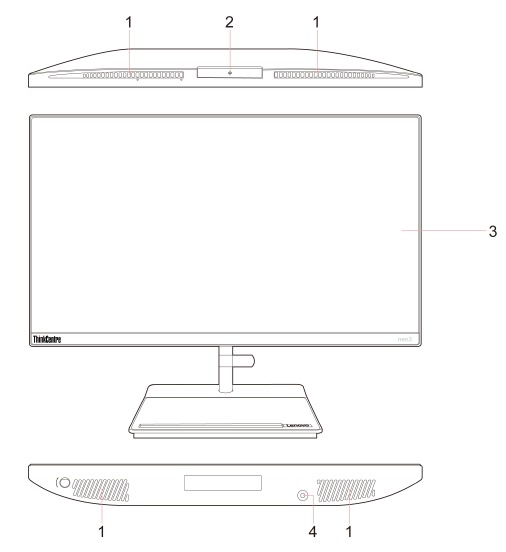
- Air vents
- Camera*
- Screen
- Combo audio jack
* for selected models
Rear
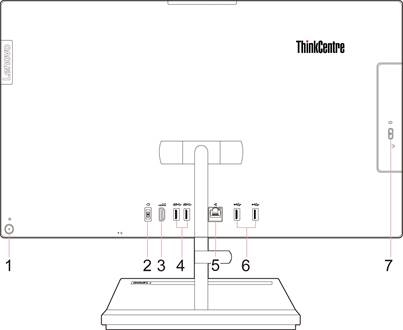
- Power button/Power button indicator
- Power connector
- HDMI ™ out connector
- USB 3.2 connectors
- Ethernet connector
- USB 2.0 connectors
- Optical drive eject button*
* for selected models
Related topics
- "Connect an external display".
- "USB specifications".
- "Use the optical drive (for selected models)".
Power indicator
Show the system status of your computer.
- Blinking for three times: The computer is initially connected to power.
- On: The computer is on.
- Off: The computer is off or in hibernation mode.
- Blinking rapidly: The computer is entering sleep or hibernation mode.
- Blinking slowly: The computer is in sleep mode.
Features and specifications
For detailed specifications of your computer, go to https://psref.lenovo.com.
| Dimensions |
|
| Weight (without packaging) | Maximum configuration as shipped:
|
| Hardware configuration | Type Device Manager in the Windows search box and then press Enter. Type the administrator password or provide confirmation, if prompted. |
| Power supply | 90-watt automatic voltage-sensing power supply |
| Electrical input |
|
| Memory | Double data rate 4 (DDR4) small outline dual in-line memory module (SODIMM) |
| Storage device |
Note: The storage drive capacity indicated by the system is less than the nominal capacity. |
| Video features |
|
| Expansion |
|
| Network features |
|
USB specifications
Note: Depending on the model, some USB connectors might not be available on your computer.
| Connector name | Description |

| Connect USB-compatible devices, such as a USB keyboard, USB mouse, USB storage device, or USB printer. |

|
|
 USB 2.0 connector
 USB 3.2 connector Gen 1
 USB 3.2 connector Gen 2
 USB-C (3.2 Gen 1) connector
 USB-C (3.2 Gen 2) connector
 USB-C (Thunderbolt 3) connector
 USB-C (Thunderbolt 4) connector
Statement on USB transfer rate
Depending on many factors such as the processing capability of the host and peripheral devices, file attributes, and other factors related to system configuration and operating environments, the actual transfer rate using the various USB connectors on this device will vary and will be slower than the data rate listed below for each corresponding device.
| USB device | Data rate (Gbit/s) |
| 3.2 Gen 1 / 3.1 Gen 1 | 5 |
| 3.2 Gen 2 / 3.1 Gen 2 | 10 |
| 3.2 Gen 2 × 2 | 20 |
| Thunderbolt 3 | 40 |
| Thunderbolt 4 | 40 |
Get started with your computer
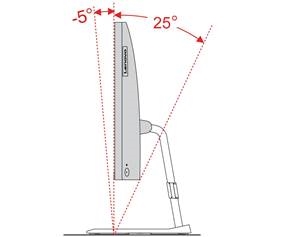
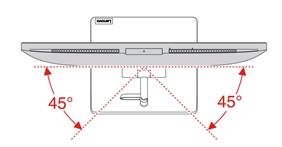
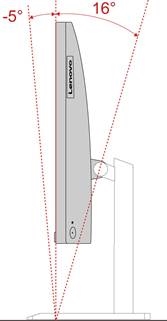
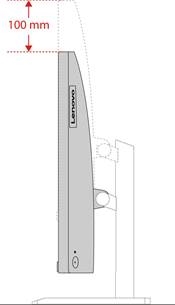
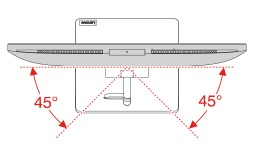
Adjust the computer stand (for selected models)
Type 1
- Adjust the vertical position
![]()
- Adjusting the left or the right angle
![]()
Type 2 (for selected 24-inch models only)
- Adjust the vertical position
![]()
- Adjust the height
![]()
- Adjusting the left or the right angle
![]()
Access networks
This section helps you access networks through connecting to a wired or wireless network.
Connect to the wired Ethernet
Connect your computer to a local network through the Ethernet connector on your computer with an Ethernet cable.
Connect to Wi-Fi networks (for selected models)
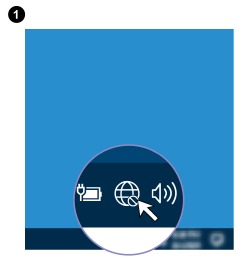
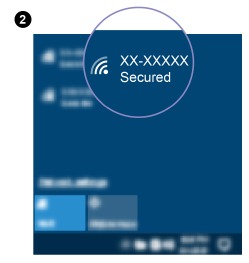
Click the network icon in the Windows® notification area, and then select a network for connection. Provide required information, if needed.
Connect an external display
Connect a projector or a monitor to your computer to give presentations or expand your workspace.
Connect a wireless display
Ensure that both your computer and the wireless display support Miracast®.
Press Windows logo key + K and then select a wireless display to connect.
Change display settings
- Right-click a blank area on the desktop and select display settings.
![]()
- Select the display that you want to configure and change display settings of your preference.
![]()
Explore your computer
The Vantage app
The preinstalled Vantage app is a customized one-stop solution to help you maintain your computer with automated updates and fixes, configure hardware settings, and get personalized support.
To access the Vantage app, type Vantage in the Windows search box.
Key features
The Vantage app enables you to:
- Know the device status easily and customize device settings.
- Download and install UEFI BIOS, firmware and driver updates to keep your computer up-to-date.
- Monitor your computer health, and secure your computer against outside threats.
- Scan your computer hardware and diagnose hardware problems.
- Look up warranty status (online).
- AccessUser Guide and helpful articles.
Notes:
- The available features vary depending on the computer model.
- The Vantage app makes periodic updates of the features to keep improving your experience with your computer. The description of features might be different from that on your actual user interface.
Night light
Blue light is the high-energy visible light in the light spectrum. Excessive exposure to blue light might damage your vision. Night light is a feature that reduces the blue light emitted by computer displays. When the night light is on, your computer display shows warmer colors that help you reduce eye strain.
To turn on or turn off the night light, type Night light in the Windows search box and then press Enter. Then, follow the on-screen instructions.
Note: Selected Lenovo computers are low blue-light certified. These computers are tested with night light turned on and color temperature set to the default value of 48.
Set the power plan
For ENERGY STAR® compliant computers, the following power plan takes effect when your computers have been idle for a specified duration:
- turn off the display: After 10 minutes
- put the computer to sleep: After 10 minutes
To awaken the computer from Sleep mode, press any key on your keyboard.
To reset the power plan:
- Right-click the battery status icon and select Power Options.
- Choose or customize a power plan of your preference.
Transfer data
Quickly share your files using the built-in Bluetooth technology among devices with the same features. You also can install a disc or media card to transfer data.
Connect to a Bluetooth-enabled device (for selected models)
You can connect all types of Bluetooth-enabled devices to your computer, such as a keyboard, a mouse, a smartphone, or speakers. Place the device that you are attempting to connect to less than 10 meters (33 feet) from the computer.
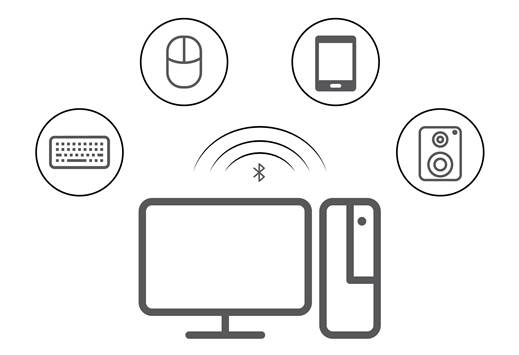
- Type Bluetooth in the Windows search box and then press Enter.
- Turn on Bluetooth, if it is off.
- Select a Bluetooth device, and then follow the on-screen instructions.
Use the optical drive (for selected models)
If your computer has an optical drive, read the following information.
Know the type of your optical drive
- Type Device Manager in the Windows search box and then press Enter. Type the administrator password or provide confirmation, if prompted.
- Select an optical drive, and then follow the on-screen instructions.
Install or remove a disc
- With the computer on, press the eject button on the optical drive. The tray slides out of the drive.
- Insert a disc into the tray or remove a disc from the tray, and then push the tray back into the drive.
Note: If the tray does not slide out of the drive when you press the eject button, turn off the computer. Then, insert a straightened paper clip into the emergency-eject hole adjacent to the eject button. Use the emergency eject only in an emergency.
Record a disc
- Insert a recordable disc into the optical drive that supports recording.
- Do one of the following:
- Type AutoPlay in the Windows search box and then press Enter. Turn on Use AutoPlay for all media and devices.
- Open Windows Media Player.
- Double-click the ISO file.
- Follow the on-screen instructions.
Purchase accessories
Lenovo has a number of hardware accessories and upgrades to help expand the capabilities of your computer. Options include memory modules, storage devices, network cards, power adapters, keyboards, mice, and more.
To shop at Lenovo, go to https://www.lenovo.com/accessories.
Secure your computer and information
Log in to your computer securely
This section provides secure ways to log in to your computer with a password or your face.
UEFI BIOS passwords
You can set passwords in UEFI (Unified Extensible Firmware Interface) BIOS (Basic Input/Output System) to strengthen the security of your computer.
Password types
You can set a power-on password, supervisor password, system management password, or hard disk password in UEFI BIOS to prevent unauthorized access to your computer. However, you are not prompted to enter any UEFI BIOS password when your computer resumes from sleep mode.
- Power-on password
When a power-on password is set, you are prompted to enter a valid password each time the computer is turned on. - Supervisor password
Setting a supervisor password deters unauthorized users from changing configuration settings. If you are responsible for maintaining the configuration settings of several computers, you might want to set a supervisor password.
When a supervisor password is set, you are prompted to enter a valid password each time you try to enter the BIOS menu.
If both the power-on password and supervisor password are set, you can enter either password. However, you must use your supervisor password to change any configuration settings. - Hard disk password
Setting a hard disk password prevents unauthorized access to the data on the storage drive. When a hard disk password is set, you are prompted to enter a valid password each time you try to access the storage drive.
Note: After you set a hard disk password, your data on the storage drive is protected even if the storage drive is removed from one computer and installed in another.
Set, change, and remove a password
Before you start, print these instructions.
- Restart the computer. When the logo screen is displayed, press F1 or Fn+F1.
- Select Security.
- Depending on the password type, select Set Supervisor Password, Set Power-On Password, Set System Management Password, or Hard Disk Password and press Enter.
- Follow the on-screen instructions to set, change, or remove a password.
- Press F10 or Fn+F10 to save the changes and exit.
You should record your passwords and store them in a safe place. If you forget the passwords, contact a Lenovo-authorized service provider to have the passwords removed.
Note: If the hard disk password is forgotten, Lenovo cannot remove the password or recover data from the storage drive.
Face authentication (for selected models)
Create your face ID and unlock your computer by scanning your face:
- Type Sign-in options in the Windows search box and then press Enter.
- Select the face ID setting and then follow the on-screen instruction to create your face ID.
Use software security solutions
This section provides software solutions to secure your computer and information.
Windows firewalls
A firewall can be hardware, software, or a combination of both depending on the level of security required. Firewalls work on a set of rules to determine which inbound and outbound connections are authorized. If the computer is preinstalled with a firewall program, it helps protect against computer Internet security threats, unauthorized access, intrusions, and Internet attacks. It also protects your privacy. For more information about how to use the firewall program, refer to the help system of your firewall program.
To use Windows firewalls:
- Type Control Panel in the Windows search box and then press Enter. View by large icons or small icons.
- Click Windows Defender Firewall, and then follow the on-screen instructions.
Antivirus programs
The computer is preinstalled with an antivirus program to help you guard against, detect, and eliminate viruses.
Lenovo provides a full version of antivirus software on the computer with a free 30-day subscription. After 30 days, you must renew the license to continue receiving the antivirus software updates.
Note: Virus definition files must be kept up-to-date to guard against new viruses.
For more information about how to use your antivirus software, refer to the help system of your antivirus software.
Use BIOS security solutions
This section provides BIOS solutions to secure your computer and information.
Cover presence switch
The cover presence switch prevents the computer from logging in to the operating system when the computer cover is not properly installed or closed.
To enable the cover presence switch connector on the system board:
- Restart the computer. When the logo screen is displayed, press F1 or Fn+F1.
- Select Security ➙ Cover Tamper Detected and press Enter.
- Select Enabled and press Enter.
- Press F10 or Fn+F10 to save the changes and exit.
If the cover presence switch is enabled and the computer cover is not correctly installed or closed, an error message will be displayed when you turn on the computer. To bypass the error message and log in to the operating system:
- Properly install or close the computer cover.
- Enter the BIOS menu, save and then exit.
Intel BIOS guard
The Intel® BIOS Guard module cryptographically verifies all BIOS updates. This hardware-based security helps prevent software and malware attacks on the computers BIOS.
UEFI BIOS
This chapter provides information about configuring and updating UEFI BIOS, and clearing CMOS.
What is UEFI BIOS
Note: The operating system settings might override any similar settings in UEFI BIOS.
UEFI BIOS is the first program that the computer runs when the computer is turned on. UEFI BIOS initializes the hardware components and loads the operating system and other programs. Your computer comes with a setup program with which you can change UEFI BIOS settings.
Enter the BIOS menu
Restart the computer. When the logo screen is displayed, press F1 or Fn+F1 to enter the BIOS menu.
Note: If you have set BIOS passwords, enter the correct passwords when prompted. You also can select No or press Esc to skip the password prompt and enter the BIOS menu. However, you cannot change the system configurations that are protected by passwords.
Navigate in the BIOS interface
Attention: The default configurations are already optimized for you in boldface. Improper change of the configurations might cause unexpected results.
Depending on your keyboard, you can navigate in the BIOS interface by pressing the following keys, or combinations of Fn and the following keys:
| Key | Function |
| F1 or Fn+F1 | General Help |
| Esc or Fn+Esc | Exit the submenu |
| ↑↓ or Fn+↑↓ | Locate an item |
| ← → or Fn+← → | Move keyboard focus |
| +/– or Fn++/– | Change value |
| Enter | Enter the submenu |
| F9 or Fn+F9 | Setup Defaults |
| F10 or Fn+F10 | Save and exit |
Change the display language of UEFI BIOS
UEFI BIOS supports three or four display languages: English, French, simplified Chinese, and Russian (for selected models).
To change the display language of UEFI BIOS:
- Select Main ➙ Language and press Enter.
- Set the display language as desired.
Change the display mode of UEFI BIOS (for selected models)
You can use UEFI BIOS in the graphic mode or the text mode according to your needs.
The keys on the keyboard used to perform various tasks are displayed at the bottom of the screen. In addition to the keyboard, you also can use the mouse to make selections.
To change the display mode of UEFI BIOS:
- Restart the computer. When the logo screen is displayed, press F1 or Fn+F1.
- Select Main ➙ Setup Mode Select and press Enter.
- Set the display mode as desired.
Set the system date and time
- Restart the computer. When the logo screen is displayed, press F1 or Fn+F1.
- Select Main ➙ System Time & Date and press Enter.
- Set the system date and time as desired.
- Press F10 or Fn+F10 to save the changes and exit.
Change the boot priority order
If the computer does not boot from a device as expected, you can change the boot priority order permanently or select a temporary boot device.
Change the boot priority order permanently
- Depending on the type of the storage device, do one of the following:
- If the storage device is internal, go to step 2.
- If the storage device is a disc, ensure that the computer is on or turn on the computer. Then, insert the disc into the optical drive.
- If the storage device is an external device other than a disc, connect the storage device to the computer.
- Restart the computer. When the logo screen is displayed, press F1 or Fn+F1.
- Select Startup ➙ Boot Priority Order, and then follow the on-screen instructions to change the boot priority order.
- You can also select the first priority device group by selecting Startup ➙ First Boot Device, and then follow the on-screen instructions to select the first boot device within this group. Your computer will boot from the first boot device before trying the boot priority order you set in the previous step.
- Press F10 or Fn+F10 to save the changes and exit.
Select a temporary boot device
Note: Not all discs and storage drives are bootable.
- Depending on the type of the storage device, do one of the following:
- If the storage device is internal, go to step 2.
- If the storage device is a disc, ensure that the computer is on or turn on the computer. Then, insert the disc into the optical drive.
- If the storage device is an external device other than a disc, connect the storage device to the computer.
- Restart the computer. When the logo screen is displayed, press F12 or Fn+F12.
- Select the storage device as desired and press Enter.
If you want to change the boot priority order permanently, select Enter Setup on Startup Device Menu and press Enter to enter the BIOS menu.
Enable or disable the automatic power-on feature
The Automatic Power On item in UEFI BIOS provides various options for you to make your computer start up automatically.
To enable or disable the automatic power-on feature:
- Restart the computer. When the logo screen is displayed, press F1 or Fn+F1.
- Select Power ➙ Automatic Power On and press Enter.
- Select the feature as desired and press Enter.
- Enable or disable the feature as desired.
- Press F10 or Fn+F10 to save the changes and exit.
Enable or disable the ErP LPS compliance mode
Lenovo computers meet the eco-design requirements of the ErP Lot 3 regulation. For more information, go to:
https://www.lenovo.com/us/en/compliance/eco-declaration
You can enable the ErP LPS compliance mode to reduce the consumption of electricity when the computer is off or in sleep mode.
To enable or disable the ErP LPS compliance mode:
- Restart the computer. When the logo screen is displayed, press F1 or Fn+F1.
- Select Power ➙ Enhanced Power Saving Mode and press Enter.
- Depending on whether you select Enabled or Disabled, do one of the following:
- If you select Enabled, press Enter. Then, select Power ➙ Automatic Power On and press Enter. Check whether the Wake on LAN feature is disabled automatically. If no, disable it.
- If you select Disabled, press Enter. Then, go to the next step.
- Press F10 or Fn+F10 to save the changes and exit.
When the ErP LPS compliance mode is enabled, you can wake up the computer by doing one of the following:
- Press the power button.
- Enable the Wake Up on Alarm feature to make the computer wake up at a set time.
To meet the off mode requirement of ErP compliance, you need to disable the Fast Startup function.
- Go to Control Panel and view by large icons or small icons.
- Click Power Options ➙ Choose what the power buttons do ➙ Change settings that are currently unavailable.
- Clear the Turn on fast startup (recommended) option from the Shutdown settings list.
Change the ITS performance mode
You can adjust the acoustic and thermal performance of your computer by changing the ITS performance mode. Three options are available:
- Balance mode: The computer works at the balance mode with balanced noise and better performance.
- Performance mode (default setting): The computer works at the best performance with normal acoustic level.
Note: The term "best" only refers to the best effect among different settings of the product itself. - Full Speed: All fans in the computer will run at full speed.
To change the ITS performance mode:
- Restart the computer. When the logo screen is displayed, press F1 or Fn+F1.
- Select Power ➙ Intelligent Cooling and press Enter.
- Select Performance Mode and press Enter.
- Set the performance mode as desired.
- Press F10 or Fn+F10 to save the changes and exit.
Change BIOS settings before installing a new operating system
BIOS settings vary by operating system. Change the BIOS settings before installing a new operating system.
Microsoft constantly makes updates to the Windows operating system. Before installing a particular Windows version, check the compatibility list for the Windows version. For details, go to: https://support.lenovo.com/us/en/solutions/windows-support
To change the BIOS settings:
- Restart the computer. When the logo screen is displayed, press F1 or Fn+F1.
- From the main interface, select Security ➙ Secure Boot and press Enter.
- Depending on the operating system to be installed, do one of the following:
- To install a Windows operating system that supports secure boot, select Enabled for Secure Boot.
- To install an operating system that does not support secure boot, such as some Linux operating systems, select Disabled for Secure Boot.
- Press F10 or Fn+F10 to save the changes and exit.
Update UEFI BIOS
When you install a new program, device driver, or hardware component, you might need to update UEFI BIOS. You can update the BIOS from your operating system or a flash update disc (supported only on selected models).
Download and install the latest UEFI BIOS update package by one of the following methods:
- From the Vantage app:
Open the Vantage app to check the available update packages. If the latest UEFI BIOS update package is available, follow the on-screen instructions to download and install the package. - From the Lenovo Support Web site:
- Go tohttps://pcsupport.lenovo.com.
- Download the flash BIOS update driver for the operating system version or the ISO image version (used to create a flash update disc). Then, download the installation instructions for the flash BIOS update driver you have downloaded.
- Print the installation instructions and follow the instructions to update the BIOS.
Recover from a BIOS update failure
- Remove all media from the drives and turn off all connected devices.
- Insert the BIOS update disc into the optical drive, and then turn off the computer.
- Disconnect all power cords from electrical outlets. Then, remove any parts that impede access to the JCRIS1 pads.
- Reconnect the power cords for the computer and the monitor to electrical outlets.
- Short-circuit the JCRIS1 pads, and then turn on the computer and the monitor.
- Release the JCRIS1 pads when the computer beeps. The recovery process begins.
- After the recovery process is completed, the computer will be turned off automatically.
Note: Depending on the computer model, the recovery process will take two to three minutes. - Disconnect all power cords from electrical outlets.
- Reinstall all the parts that have been removed. Then, reconnect the power cords for the computer and the monitor to electrical outlets.
- Turn on the computer and the monitor. When the logo screen is displayed, press F1 or Fn+F1.
- To prevent data loss, ensure that BIOS settings are restored to an earlier point. For BIOS configurations, see Chapter "UEFI BIOS".
Clear CMOS
- Remove all media from the drives and turn off all connected devices and the computer.
- Disconnect all power cords from electrical outlets. Then, remove any parts that impede access to the JCRIS1 pads.
- Reconnect the power cords for the computer and the monitor to electrical outlets.
- Use a flat head screwdriver to short-circuit the JCRIS1 pads. Meanwhile, turn on the computer and the monitor.
- Release the screwdriver when the computer beeps. Wait for approximately 10 seconds.
- Turn off the computer by holding the power button for approximately four seconds.
- Disconnect all power cords from electrical outlets.
- Reinstall all the parts that have been removed. Then, reconnect the power cords for the computer and the monitor to electrical outlets.
- Turn on the computer and the monitor. When the logo screen is displayed, press F1 or Fn+F1.
- To prevent data loss, ensure that BIOS settings are restored to an earlier point. For BIOS configurations, see Chapter "UEFI BIOS".
Diagnostics
Use diagnostic solutions to test hardware components and report operating-system-controlled settings that interfere with the correct operation of your computer.
Lenovo diagnostic tools
For information about Lenovo diagnostic tools, go to: https://pcsupport.lenovo.com/lenovodiagnosticsolutions
The Vantage app
The Vantage app is preinstalled on your computer. To diagnose problems with the Vantage app:
- Type Vantage in the Windows search box and press Enter.
- Follow the on-screen instructions and run a hardware scan.
If you are unable to isolate and resolve the problem after running the Vantage app, save and print the log files created by the program. You might need the log files when you speak to a Lenovo technical support representative.
CRU replacement
Customer Replaceable Units (CRUs) are parts that can be upgraded or replaced by the customer. Lenovo computers contain the following types of CRUs:
- Self-service CRUs: Refer to parts that can be installed or replaced easily by customer themselves or by trained service technicians at an additional cost.
- Optional-service CRUs: Refer to parts that can be installed or replaced by customers with a greater skill level. Trained service technicians can also provide service to install or replace the parts under the type of warranty designated for the customer's machine.
If you intend on installing the CRU, Lenovo will ship the CRU to you. CRU information and replacement instructions are shipped with your product and are available from Lenovo at any time upon request. You might be required to return the defective part that is replaced by the CRU. When return is required: (1) return instructions, a prepaid shipping label, and a container will be included with the replacement CRU; and (2) you might be charged for the replacement CRU if Lenovo does not receive the defective CRU within thirty (30) days of your receipt of the replacement CRU. For full details, see the Lenovo Limited Warranty documentation at: https://www.lenovo.com/warranty/llw_02
CRU list
The following is the CRU list of your computer.
Self-service CRUs
- Keyboard
- Mouse
- Ac power adapter
- Power cord
- Computer stand
Remove or replace a CRU
This section provides instructions on how to remove or replace a CRU.
Power cord and ac power adapter
Prerequisite
Before you start, read Generic Safety and Compliance Notices, and print the following instructions.
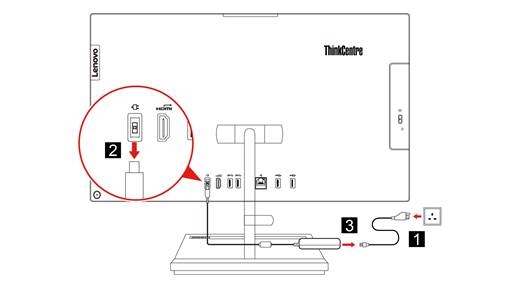
Note: Do not remove the power cord when the computer is connected to ac power. Otherwise, there might be a risk of short circuits.
For access, turn off the computer and remove all connected devices and cables.
Removal steps
Computer stand
Prerequisite
Before you start, read Generic Safety and Compliance Notices, and print the following instructions.
For access, do the following:
- Turn off the computer and remove all connected devices and cables.
- Disconnect the computer from ac power and all connected cables.
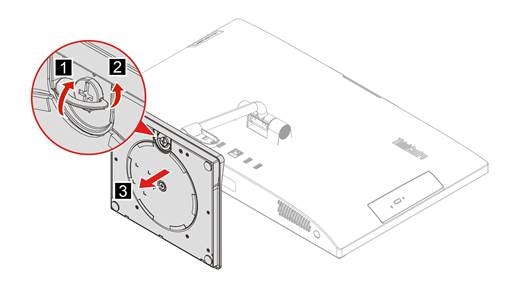
- Place a soft, clean towel or cloth on the desk or surface. Hold the sides of your computer and gently lay it down so that the screen is against the surface and the computer cover is facing up.
Removal steps
Help and support
Self-help resources
Use the following self-help resources to learn more about the computer and troubleshoot problems.
| Resources | How to access? |
| Troubleshooting and frequently asked questions |
|
| Accessibility information | https://www.lenovo.com/accessibility |
| Reset or restore Windows |
|
Use the Vantage app to:
| Type Vantage in the Windows search box. |
Product documentation:
| Go to https://pcsupport.lenovo.com . Then, follow the onscreen instructions to filter out the documentation you want. |
Lenovo Support Web site with the latest support information of the following:
| https://pcsupport.lenovo.com |
| Windows help information |
|
Call Lenovo
If you have tried to correct the problem yourself and still need help, you can call Lenovo Customer Support Center.
Before you contact Lenovo
Prepare the following before you contact Lenovo:
- Record the problem symptoms and details:
- What is the problem? Is it continuous or intermittent?
- Any error message or error code?
- What operating system are you using? Which version?
- Which software applications were running at the time of the problem?
- Can the problem be reproduced? If so, how?
- Record the system information:
- Product name
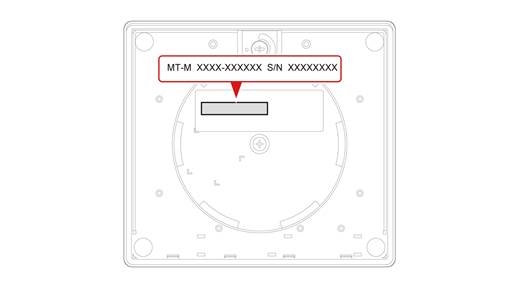
- Machine type and serial number
The following illustration shows where to find the machine type and serial number of your computer.

Lenovo Customer Support Center
During the warranty period, you can call Lenovo Customer Support Center for help.
Telephone numbers
For a list of the Lenovo Support phone numbers for your country or region, go to: https://pcsupport.lenovo.com/supportphonelist
Note: Phone numbers are subject to change without notice. If the number for your country or region is not provided, contact your Lenovo reseller or Lenovo marketing representative.
Services available during the warranty period
- Problem determination - Trained personnel are available to assist you with determining if you have a hardware problem and deciding what action is necessary to fix the problem.
- Lenovo hardware repair - If the problem is determined to be caused by Lenovo hardware under warranty, trained service personnel are available to provide the applicable level of service.
- Engineering change management - Occasionally, there might be changes that are required after a product has been sold. Lenovo or your reseller, if authorized by Lenovo, will make selected Engineering Changes (ECs) that apply to your hardware available.
Services not covered
- Replacement or use of parts not manufactured for or by Lenovo or nonwarranted parts
- Identification of software problem sources
- Configuration of UEFI BIOS as part of an installation or upgrade
- Changes, modifications, or upgrades to device drivers
- Installation and maintenance of network operating systems (NOS)
- Installation and maintenance of programs
For the terms and conditions of the Lenovo Limited Warranty that apply to your Lenovo hardware product, see Safety and Warranty Guide that comes with your computer.
Purchase additional services
During and after the warranty period, you can purchase additional services from Lenovo at: https://pcsupport.lenovo.com/warrantyupgrade
Service availability and service name might vary by country or region.
Compliance information
For more compliance information, refer to Regulatory Notice at https://pcsupport.lenovo.com and Generic Safety and Compliance Notices at https://pcsupport.lenovo.com/docs/generic_notices.
Certification-related information
| Product name | Machine types |
| ThinkCentre neo 30a 22 Gen 3 | 12B1 and 12B3 |
| ThinkCentre neo 30a 24 Gen 3 | 12CE,12B0 and 12B2 |
Further compliance information related to your product is available at https://www.lenovo.com/compliance.
References
![www.lenovo.com]() Lenovo Accessories & Software - Shop Now | Lenovo US
Lenovo Accessories & Software - Shop Now | Lenovo USOfficial Lenovo Laptop, Accessories & PC Support - Lenovo Support US
Product Specifications Reference (PSREF)
![www.lenovo.com]() Eco Declarations & PCF | Regulatory Compliance | Lenovo US
Eco Declarations & PCF | Regulatory Compliance | Lenovo USLenovo Diagnostics Solutions: Overview - Lenovo Support US
(English) Generic Safety and Compliance Notices - Lenovo Support US
![forums.lenovo.com]() English Community-Lenovo Community
English Community-Lenovo Community![www.lenovo.com]() Product Accessibility | Regulatory Compliance | Lenovo US
Product Accessibility | Regulatory Compliance | Lenovo US![support.microsoft.com]() Microsoft Support
Microsoft SupportSupportPhoneList - Lenovo Support US
Lenovo Warranty Check | Device Warranty Lookup | Lenovo Support US
![www.lenovo.com]() Compliance | Lenovo US
Compliance | Lenovo US


Download manual
Here you can download full pdf version of manual, it may contain additional safety instructions, warranty information, FCC rules, etc.
Download Lenovo ThinkCentre Neo 30a, ThinkCentre Neo 30a 22 Gen 3 Manual


