Carrier 30HXC/30GX Screw Compressor Manual
- 1 INTRODUCTION
- 2 SAFETY CONSIDERATIONS
- 3 DIMENSIONS, CLEARANCES, WEIGHT DISTRIBUTION
- 4 PHYSICAL DATA 30HXC
- 5 ELECTRICAL DATA 30HXC
- 6 ELECTRICAL DATA FOR UNITS WITH HIGH CONDENSING TEMPERATURES
- 7 PHYSICAL DATA 30GX
- 8 ELECTRICAL DATA 30GX
- 9 APPLICATION DATA
- 10 INSTALLATION
- 11 LIFTING INSTRUCTIONS
- 12 ELECTRICAL CHARACTERISTICS
- 13 RECOMMENDED WIRE SECTIONS
- 14 MAJOR SYSTEM COMPONENTS AND OPERATION DATA
- 15 MAINTENANCE
- 16 Troubleshooting
- 17 Download manual
- 18 In Other Languages
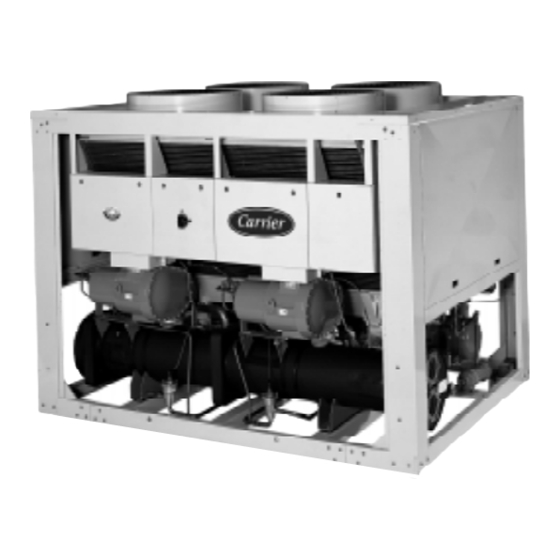
INTRODUCTION
Prior to initial start-up of the 30HXC and 30GX unit, those involved in the start-up, operation, and maintenance should be thoroughly familiar with these instructions and other necessary job data. This book provides an overview so that you may become familiar with the control system before performing start-up procedures. Procedures in this manual are arranged in the sequence required for proper machine start-up and operation.
SAFETY CONSIDERATIONS
30HXC and 30GX liquid chillers are designed to provide safe and reliable service when operated within design specifications. When operating this equipment, use good judgment and safety precautions to avoid damage to equipment and property or injury to personnel.
Be sure you understand and follow the procedures and safety precautions contained in the machine instructions as well as those listed in this guide.

DO NOT VENT refrigerant relief valves within a building. Outlet from relief valve must be vented outdoors. The accumulation of refrigerant in an enclosed space can displace oxygen and cause asphyxiation or explosions.
PROVIDE adequate ventilation, especially for enclosed and low overhead spaces. Inhalation of high concentrations of vapor is harmful and may cause heart irregularities, unconsciousness, or death. Vapor is heavier than air and reduces the amount of oxygen available for breathing. Product causes eye and skin irritation. Decomposition products are hazardous.
DO NOT USE OXYGEN to purge lines or to pressurize a machine for any purpose. Oxygen gas reacts violently with oil, grease, and other common substances.
NEVER EXCEED specified test pressures, VERIFY the allowable test pressure by checking the instruction literature and the design pressures on the equipment nameplate.
DO NOT USE air for leak testing. Use only refrigerant or dry nitrogen.
DO NOT VALVE OFF any safety device.
BE SURE that all pressure relief devices are properly installed before operating any machine.

DO NOT WELD OR FLAMECUT any refrigerant line or vessel until all refrigerant (liquid and vapor) has been removed from chiller. Traces of vapor should be displaced with dry air nitrogen and the work area should be well ventilated. Refrigerant in contact with an open flame produces toxic gases.
DO NOT work on energized equipment unless you are a skilled electrician.
DO NOT WORK ON electrical components, including control panels, switches, relays etc, until you are sure ALL POWER IS OFF and residual voltage can leak from capacitors or solid state components.
LOCK OPEN AND TAG electrical circuits during servicing. IF WORK IS INTERRUPTED, check that all circuits are deenergized before resuming work.
DO NOT siphon refrigerant.
AVOID SPILLING liquid refrigerant on skin or getting it into the eyes. USE SAFETY GOGGLES. Wash any spills from the skin with soap and water. If liquid refrigerant enters the eyes,
IMMEDIATELY FLUSH EYES with water and consult a physician.
NEVER APPLY an open flame or live steam to refrigerant container. Dangerous overpressure can result. If it is necessary to heat refrigerant, use only warm water.
DO NOT REUSE disposable (non-returnable) cylinders or attempt to refill them. It is DANGEROUS AND ILLEGAL. When cylinders are emptied, evacuate remaining gas pressure, loosen the collar and unscrew and discard the valve stem. DO NOT INCINERATE.
CHECK THE REFRIGERANT TYPE before adding refrigerant to the machine. The introduction of the wrong refrigerant can cause damage or malfunction to this machine.
DO NOT ATTEMPT TO REMOVE fittings, components, etc., while machine is under pressure or while machine is running. Be sure pressure is at 0 kPa before breaking refrigerant connection.
CAREFULLY INSPECT all relief devices, AT LEAST ONCE A YEAR. If machine operates in a corrosive atmosphere, inspect the devices at more frequent intervals.
DO NOT ATTEMPT TO REPAIR OR RECONDITION any relief device when corrosion or build-up of foreign material (rust, dirt, scale, etc.) is found within the valve body or mechanism. Replace the device.
DO NOT install relief devices in series or backwards.

DO NOT STEP on refrigerant lines. Broken lines can whip about and release refrigerant, causing personal injury.
DO NOT climb over a machine. Use platform, or staging.
USE MECHANICAL EQUIPMENT (crane, hoist, etc.) to lift or move heavy components. Even if components are light, use mechanical equipment when there is a risk of slipping or losing your balance.
BE AWARE that certain automatic start arrangements CAN ENGAGE TOWER FAN, OR PUMPS. Open the disconnect ahead of the tower fans, or pumps.
USE only repair or replacement parts that meet the code requirements of the original equipment.
DO NOT VENT OR DRAIN water boxes containing industrial brines, without the permission of a competent body.
DO NOT LOOSEN water box bolts until the water box has been completely drained.
DO NOT LOOSEN a packing gland nut before checking that the nut has a positive thread engagement.
PERIODICALLY INSPECT all valves, fittings, and piping for corrosion, rust, leaks, or damage.
PROVIDE A DRAIN connection in the vent line near each pressure relief device to prevent a build-up of condensate or rain water.
DIMENSIONS, CLEARANCES, WEIGHT DISTRIBUTION
30HXC 080-190
30HXC080
30HXC090
30HXC100
30HXC110

- Evaporator
- Condenser
- Clearances required for operation and maintenance
- Clearances required for heat exchanger tube removal. Clearances D and E can be either on the left or on the right hand side.
 Water inlet
 Water outlet
 Power supply
kg: total operating weight
| A mm | B mm | C mm | D mm | E mm | kg | |
| 30HXC080 30HXC090 30HXC100 |
2705 | 950 | 1850 | 2360 | 1000 | 2447 2462 2504 |
| 30HXC110 | 2705 | 950 | 1900 | 2360 | 1000 | 2650 |
| 30HXC120 30HXC130 30HXC140 30HXC155 |
3535 | 950 | 1875 | 3220 | 1000 | 2846 2861 2956 2971 |
| 30HXC175 30HXC190 |
3550 | 950 | 2000 | 3220 | 1000 | 3283 3438 |
NOTE: Refer to the certified dimensional drawings supplied with the unit, when designing an installation.
30HXC 200-375

- Evaporator
- Condenser
- Clearances required for operation and maintenance
- Clearances required for heat exchanger tube removal. Clearances D and E can be either on the left or on the right hand side.
Water inlet
Water outlet
Power supply
kg: total operating weight
| A mm | B mm | C mm | D mm | E mm | kg | |
| 30HXC200 | 3975 | 980 | 2035 | 3620 | 1000 | 4090 |
| 30HXC230 30HXC260 30HXC285 |
3995 | 980 | 2116 | 3620 | 1000 | 4705 4815 4985 |
| 30HXC310 30HXC345 30HXC375 |
4490 | 980 | 2163 | 4120 | 1000 | 5760 5870 6105 |
NOTE: Refer to the certified dimensional drawings supplied with the unit, when designing an installation.
30GX 082-182
30GX-082
30GX-092
30GX-102
30GX-112
30GX-122
30GX-132
30GX-152
30GX-162
30GX-182


- Clearances required for operation and maintenance
- Clearances required for heat exchanger tube removal. Clearances can be either on the left or on the right hand side.
Water inlet
Water outlet
Power supply
 Air outlet - do not obstruct
kg: total operating weight
| A mm | B mm | kg | |
| 30GX082 30GX092 30GX102 |
2970 | 2215 | 3116 3157 3172 |
| 30GX112 30GX122 30GX132 |
3427 | 2045 | 3515 3531 3633 |
| 30GX152 30GX162 |
4342 | 2835 | 3920 3936 |
| 30GX182 | 5996 | 1820 | 4853 |
Multiple chiller installation


Notes:
- Unit must have clearances for air flow as follows:
Top: do not restrict in any way - In case of multiple chillers (up to four units), the respective clearance between them should be increased from 1830 to 2000 mm for the side space requirement.
- Clearances sre required for cooler tube removal.
NOTE: Refer to the certified dimensional drawings supplied with the unit, when designing an installation.
30GX 207-358
30GX-207
30GX-227
30GX-247
30GX-267
30GX-298
30GX-328
30GX-358

- Clearances required for operation and maintenance
- Clearances required for heat exchanger tube removal. Clearances can be either on the left or on the right hand side.
Water inlet
Water outlet
Power supply
Air outlet - do not obstruct
kg: total operating weight
| A mm | B mm | kg | |
| 30GX207 30GX227 |
5996 | 2895 | 5540 5570 |
| 30GX247 30GX267 |
6911 | 2470 | 6134 6365 |
| 30GX298 | 7826 | 2220 | 7354 |
| 30GX328 30GX358 |
8741 | 1250 | 7918 8124 |
Multiple chiller installation
Notes:
- Unit must have clearances for air flow as follows:
Top: do not restrict in any way - In case of multiple chillers (up to four units), the respective clearance between them should be increased from 1830 to 2000 mm for the side space requirement.
- Clearances sre required for cooler tube removal.
NOTE: Refer to the certified dimensional drawings supplied with the unit, when designing an installation.
PHYSICAL DATA 30HXC
| 30HXC | 080 | 090 | 100 | 110 | 120 | 130 | 140 | 155 | 175 | 190 | 200 | 230 | 260 | 285 | 310 | 345 | 375 | |
| Net cooling capacity | kW | 292 | 321 | 352 | 389 | 426 | 464 | 514 | 550 | 607 | 663 | 716 | 822 | 918 | 996 | 1119 | 1222 | 1326 |
| Operating weight | kg | 2447 | 2462 | 2504 | 2650 | 2846 | 2861 | 2956 | 2971 | 3283 | 3438 | 4090 | 4705 | 4815 | 4985 | 5760 | 5870 | 6105 |
| Refrigerant Circuit A/B |
HFC-134a | |||||||||||||||||
| kg | 39/36 | 39/36 | 37/32 | 38/38 | 57/55 | 59/50 | 56/50 | 59/52 | 58/61 | 60/70 | 110/58 | 118/63 | 120/75 | 120/75 | 108/110 | 110/110 | 110/120 | |
| Oil Circuit A/B |
Polyolester oil CARRIER SPEC: PP 47-32 | |||||||||||||||||
| l | 15/15 | 15/15 | 15/15 | 15/15 | 15/15 | 15/15 | 15/15 | 15/15 | 15/15 | 15/15 | 30/15 | 30/15 | 30/15 | 30/15 | 30/30 | 30/30 | 30/30 | |
| Compressors | Hermetic twin-screw Power3 | |||||||||||||||||
| Circ. A, nom. size per compressor** | 39 | 46 | 46 | 56 | 56 | 66 | 80 | 80 | 80 | 80+ | 66/56 | 80/56 | 80/80 | 80+/80+ | 80/66 | 80/80 | 80+/80+ | |
| Circ. B, nom. size per compressor** | 39 | 39 | 46 | 46 | 56 | 56 | 56 | 66 | 80 | 80+ | 66 | 80 | 80 | 80+ | 80/66 | 80/80 | 80+/80+ | |
| Control type | PRO-DIALOG Plus control | |||||||||||||||||
| Number of capacity steps | 6 | 6 | 6 | 6 | 6 | 6 | 6 | 6 | 6 | 6 | 8 | 8 | 8 | 8 | 10 | 10 | 10 | |
| Minimum capacity | % | 19 | 19 | 21 | 19 | 21 | 19 | 17 | 19 | 21 | 21 | 14 | 14 | 14 | 14 | 10 | 10 | 10 |
| Evaporator | Shell and tube type, with internally finned copper tubes | |||||||||||||||||
| Net water volume | l | 65 | 65 | 73 | 87 | 81 | 81 | 91 | 91 | 109 | 109 | 140 | 165 | 181 | 181 | 203 | 229 | 229 |
| Water connections | Factory-supplied flat flange, to be welded on site | |||||||||||||||||
| Inlet and outlet | in. | 4 | 4 | 4 | 5 | 5 | 5 | 5 | 5 | 5 | 5 | 6 | 6 | 6 | 6 | 8 | 8 | 8 |
| Drain and vent (NPT) | in. | 3/8 | 3/8 | 3/8 | 3/8 | 3/8 | 3/8 | 3/8 | 3/8 | 3/8 | 3/8 | 3/8 | 3/8 | 3/8 | 3/8 | 3/8 | 3/8 | 3/8 |
| Max. water-side operating pressure | kPa | 1000 | 1000 | 1000 | 1000 | 1000 | 1000 | 1000 | 1000 | 1000 | 1000 | 1000 | 1000 | 1000 | 1000 | 1000 | 1000 | 1000 |
| Condensers | Shell and tube type, with internally finned copper tubes | |||||||||||||||||
| Net water volume | l | 58 | 58 | 58 | 58 | 92 | 92 | 110 | 110 | 132 | 132 | 162 | 208 | 208 | 208 | 251 | 251 | 251 |
| Water connections | Factory-supplied flat flange, to be welded on site | |||||||||||||||||
| Inlet and outlet | in. | 5 | 5 | 5 | 5 | 5 | 5 | 5 | 5 | 6 | 6 | 6 | 6 | 6 | 6 | 8 | 8 | 8 |
| Drain and vent (NPT) | in. | 3/8 | 3/8 | 3/8 | 3/8 | 3/8 | 3/8 | 3/8 | 3/8 | 3/8 | 3/8 | 3/8 | 3/8 | 3/8 | 3/8 | 3/8 | 3/8 | 3/8 |
| Max. water-side operating pressure | kPa | 1000 | 1000 | 1000 | 1000 | 1000 | 1000 | 1000 | 1000 | 1000 | 1000 | 1000 | 1000 | 1000 | 1000 | 1000 | 1000 | 1000 |
* Standardised Eurovent conditions: evaporator entering/leaving water temperatures = 12°C/7°C, condenser water entering/leaving water temperatures = 30°C/35°C Net cooling capacity: Gross cooling capacity minus the water pump heat against the internal evaporator pressure drop. ** The compressor size corresponds to the nominal capacity in tons (1 ton = 3.517 kW).
ELECTRICAL DATA 30HXC
| 30HXC | 080 | 090 | 100 | 110 | 120 | 130 | 140 | 155 | 175 | 190 | 200 | 230 | 260 | 285 | 310 | 345 | 375 | |
| Power circuit | ||||||||||||||||||
| Nominal power supply* | V-ph-Hz | 400-3-50 | ||||||||||||||||
| Voltage range | V | 360-440 | ||||||||||||||||
| Control circuit supply | The control circuit is supplied via the factory-installed transformer | |||||||||||||||||
| Nominal power input* | kW | 59 | 67 | 74 | 83 | 88 | 99 | 112 | 123 | 135 | 146 | 156 | 179 | 201 | 219 | 245 | 274 | 298 |
| Nominal current drawn* | A | 98 | 111 | 124 | 139 | 148 | 166 | 186 | 204 | 226 | 242 | 259 | 291 | 335 | 367 | 408 | 456 | 498 |
| Max. power input** | kW | 76 | 83 | 91 | 101 | 111 | 121 | 135 | 145 | 158 | 181 | 187 | 214 | 237 | 272 | 290 | 316 | 362 |
| Circuit A | kW | - | - | - | - | - | - | - | - | - | - | 121 | 135 | 158 | 181 | 145 | 158 | 181 |
| Circuit B | kW | - | - | - | - | - | - | - | - | - | - | 66 | 79 | 79 | 91 | 145 | 158 | 181 |
| Cosine phi, unit at full load | 0.87 | 0.87 | 0.87 | 0.87 | 0.87 | 0.87 | 0.87 | 0.87 | 0.87 | 0.87 | 0.87 | 0.87 | 0.87 | 0.87 | 0.87 | 0.87 | 0.87 | |
| Max. current drawn (Un - 10%)*** | A | 138 | 152 | 166 | 184 | 202 | 221 | 245 | 264 | 288 | 330 | 341 | 389 | 432 | 495 | 528 | 576 | 660 |
| Circuit A | A | - | - | - | - | - | - | - | - | - | - | 221 | 245 | 288 | 330 | 264 | 288 | 330 |
| Circuit B | A | - | - | - | - | - | - | - | - | - | - | 120 | 144 | 144 | 165 | 264 | 288 | 330 |
| Maximum current drawn (Un)*** | A | 125 | 138 | 151 | 167 | 184 | 201 | 223 | 240 | 262 | 300 | 310 | 354 | 393 | 450 | 480 | 524 | 600 |
| Circuit A | A | - | - | - | - | - | - | - | - | - | - | 201 | 223 | 262 | 300 | 240 | 262 | 300 |
| Circuit B | A | - | - | - | - | - | - | - | - | - | - | 109 | 131 | 131 | 150 | 240 | 262 | 300 |
| Max. starting current, std. unit (Un)**** | A | 172 | 197 | 209 | 235 | 252 | 283 | 318 | 335 | 357 | 420 | 806 | 938 | 977 | 1156 | 1064 | 1108 | 1306 |
| Circuit A | A | - | - | - | - | - | - | - | - | - | - | 697 | 807 | 846 | 1006 | 824 | 846 | 1006 |
| Circuit B | A | - | - | - | - | - | - | - | - | - | - | 605 | 715 | 715 | 856 | 824 | 846 | 1006 |
| Max. starting current/max. current draw ratio, unit | 1.37 | 1.42 | 1.39 | 1.41 | 1.37 | 1.41 | 1.43 | 1.40 | 1.36 | 1.40 | 2.60 | 2.65 | 2.49 | 2.57 | 2.22 | 2.12 | 2.18 | |
| Max. starting current/max. current draw ratio, circuit A | - | - | - | - | - | - | - | - | - | - | 3.47 | 3.62 | 3.23 | 3.35 | 3.43 | 3.23 | 3.35 | |
| Max. starting current/max. current draw ratio, circuit B | - | - | - | - | - | - | - | - | - | - | 5.55 | 5.46 | 5.46 | 5.71 | 3.43 | 3.23 | 3.35 | |
| Max. starting current - reduced current start (Un) **** | A | std. | std. | std. | std. | std. | std. | std. | std. | std. | std. | 601 | 643 | 682 | 760 | 769 | 813 | 910 |
| Circuit A | A | std. | std. | std. | std. | std. | std. | std. | std. | std. | std. | 492 | 512 | 551 | 610 | 529 | 551 | 610 |
| Circuit B | A | std. | std. | std. | std. | std. | std. | std. | std. | std. | std. | 330 | 370 | 370 | 385 | 529 | 551 | 610 |
| Max.starting current - red. current start/ max. current draw ratio, unit | std. | std. | std. | std. | std. | std. | std. | std. | std. | std. | 1.94 | 1.82 | 1.74 | 1.69 | 1.60 | 1.55 | 1.52 | |
| Circuit A | std. | std. | std. | std. | std. | std. | std. | std. | std. | std. | 2.45 | 2.30 | 2.10 | 2.03 | 2.20 | 2.10 | 2.03 | |
| Circuit B | std. | std. | std. | std. | std. | std. | std. | std. | std. | std. | 3.03 | 2.83 | 2.83 | 2.57 | 2.20 | 2.10 | 2.03 | |
| Three-phase short circuit holding current | kA | 25 | 25 | 25 | 25 | 25 | 25 | 25 | 25 | 25 | 25 | N/A | N/A | N/A | N/A | N/A | N/A | N/A |
| Circuit A | kA | - | - | - | - | - | - | - | - | - | - | 25 | 25 | 25 | 25 | 25 | 25 | 25 |
| Circuit B | kA | - | - | - | - | - | - | - | - | - | - | 15 | 15 | 15 | 15 | 25 | 25 | 25 |
| Customer standby capacity, unit or circ. A, for evaporatorwater pump connections† | kW | 8 | 8 | 8 | 11 | 11 | 11 | 15 | 15 | 15 | 15 | 15 | 18 | 18 | 30 | 30 | 30 | 30 |
* Standard Eurovent conditions: Evaporator entering/leaving water temperature 12°C and 7°C. Condenser entering/leaving water temperature 30°C/35°C.
** Power input, compressor, at unit operating limits (evaporator water entering/leaving temperature = 15°C/10°C, condenser entering/leaving water temperature = 40°C/45°C) and a nominal voltage of 400 V (data given on the unit name plate).
*** Maximum unit operating current at maximum unit power input.
**** Maximum instantaneous starting current (maximum operating current of the smallest compressor(s) + locked rotor current or reduced starting current of the largest compressor)
† Current and power inputs not included in the values above.
N/A Not available
Compressors
| Reference | Size | I nom. | MHA | LRA | LRA (Y) | LRA (S) 1 cp. | LRA (S) 2 cp. |
| 06NW2146S7N | 39 | 48 | 69 | 344 | 109 | 125 | - |
| 06NW2174S7N | 46 | 58 | 83 | 423 | 134 | 154 | - |
| 06NW2209S7N | 56 | 71 | 101 | 506 | 160 | 260 | 350 |
| 06NW2250S7N | 66 | 87 | 120 | 605 | 191 | 330 | 400 |
| 06NW2300S5N | 80 | 104 | 144 | 715 | 226 | 370 | 420 |
| 06NW2300S5E | 80+ | 111 | 165 | 856 | 270 | 385 | 460 |
Legend:
| 06NW | Compressor for water-cooled units |
| N | Non-economized compressor |
| E | Economized compressor |
| INOM | Average current draw of the compressor at Eurovent conditions |
| MHA | Must hold amperes (maximum operating current) at 360 V |
| LRA | Locked rotor current with across-the-line start |
| LRA (Y) | Locked rotor current at reduced current (star/delta start-up mode) |
| LRA (S) 1 cp. | Start-up with reduced current with electronic starter (start-up duration 3 seconds max.) for one compressor per circuit |
| LRA (S) 2 cp. | Start-up with reduced current with electronic starter (start-up duration 3 seconds max.) for two compressors per circuit |
ELECTRICAL DATA FOR UNITS WITH HIGH CONDENSING TEMPERATURES
30HXC 150 and 150A Options
| 30HXC | 080 | 090 | 100 | 110 | 120 | 130 | 140 | 155 | 175 | 190 | 200 | 230 | 260 | 285 | 310 | 345 | 375 | |
| Power circuit | ||||||||||||||||||
| Nominal power supply* | V-ph-Hz | 400-3-50 | ||||||||||||||||
| Voltage range | V | 360-440 | ||||||||||||||||
| Control circuit supply | The control circuit is supplied via the factory-installed transformer | |||||||||||||||||
| Max. power input** | kW | 104 | 117 | 131 | 145 | 159 | 174 | 194 | 211 | 230 | 263 | 271 | 310 | 345 | 395 | 422 | 460 | 526 |
| Circuit A | kW | - | - | - | - | - | - | - | - | - | - | 175 | 195 | 230 | 263 | 211 | 230 | 263 |
| Circuit B | kW | - | - | - | - | - | - | - | - | - | - | 96 | 115 | 115 | 132 | 211 | 230 | 263 |
| Max. current drawn (Un - 10%)*** | A | 190 | 215 | 240 | 265 | 290 | 320 | 355 | 385 | 420 | 480 | 495 | 564 | 630 | 720 | 770 | 840 | 960 |
| Circuit A | A | - | - | - | - | - | - | - | - | - | - | 320 | 355 | 420 | 480 | 385 | 420 | 480 |
| Circuit B | A | - | - | - | - | - | - | - | - | - | - | 175 | 210 | 210 | 240 | 385 | 420 | 480 |
| Maximum current drawn (Un)*** | A | 173 | 195 | 218 | 241 | 264 | 291 | 323 | 350 | 382 | 436 | 450 | 514 | 573 | 655 | 700 | 764 | 873 |
| Circuit A | A | - | - | - | - | - | - | - | - | - | - | 291 | 323 | 382 | 436 | 350 | 382 | 436 |
| Circuit B | A | - | - | - | - | - | - | - | - | - | - | 159 | 191 | 191 | 218 | 350 | 382 | 436 |
| Max. starting current, std. unit (Un)**** | A | 277 | 312 | 335 | 379 | 402 | 435 | 519 | 546 | 578 | 618 | 1251 | 1549 | 1608 | 1701 | 1735 | 1799 | 1920 |
| Circuit A | A | - | - | - | - | - | - | - | - | - | - | 1092 | 1358 | 1417 | 1483 | 1385 | 1417 | 1483 |
| Circuit B | A | - | - | - | - | - | - | - | - | - | - | 960 | 1226 | 1226 | 1265 | 1385 | 1417 | 1483 |
| Max. starting current/max. current draw ratio, unit | 1.61 | 1.60 | 1.54 | 1.57 | 1.52 | 1.49 | 1.61 | 1.56 | 1.51 | 1.42 | 2.78 | 3.02 | 2.81 | 2.60 | 2.48 | 2.36 | 2.20 | |
| Max. starting current/max. current draw ratio, circuit A | - | - | - | - | - | - | - | - | - | - | 3.75 | 4.21 | 3.71 | 3.40 | 3.96 | 3.71 | 3.40 | |
| Max. starting current/max. current draw ratio, circuit B | - | - | - | - | - | - | - | - | - | - | 6.03 | 6.42 | 6.42 | 5.80 | 3.96 | 3.71 | 3.40 | |
| Max. starting current - reduced current start (Un) **** | A | std. | std. | std. | std. | std. | std. | std. | std. | std. | std. | N/A | N/A | N/A | N/A | N/A | N/A | N/A |
| Three-phase short circuit holding current | kA | 25 | 25 | 25 | 25 | 25 | 25 | 25 | 25 | 25 | 25 | N/A | N/A | N/A | N/A | N/A | N/A | N/A |
| Circuit A | kA | - | - | - | - | - | - | - | - | - | - | 25 | 25 | 25 | 25 | 25 | 25 | 25 |
| Circuit B | kA | - | - | - | - | - | - | - | - | - | - | 15 | 15 | 15 | 15 | 25 | 25 | 25 |
| Customer standby capacity, unit or circ. A, for evaporatorwater pump connections† | kW | 8 | 8 | 8 | 11 | 11 | 11 | 15 | 15 | 15 | 15 | 15 | 18 | 18 | 30 | 30 | 30 | 30 |
** Power input, compressor, at unit operating limits (evaporator water entering/leaving temperature = 15°C/10°C, condenser entering/leaving water temperature = 40°C/45°C) and a nominal voltage of 400 V (data given on the unit name plate).
*** Maximum unit operating current at maximum unit power input.
**** Maximum instantaneous starting current (maximum operating current of the smallest compressor(s) + locked rotor current or reduced starting current of the largest compressor)
† Current and power inputs not included in the values above.
N/A Not available
The 30HXC 080-375 units for high condensing temperatures are directly derived from the standard models. Their application range is the same as that of the standard units, but permits operation at condenser leaving water temperatures up to 63°C. The PRO-DIALOG control offers all the advantages of the standard units, plus control of the condenser leaving water temperature.
The main modifications are:
- Use of 30GX compressors
- Modification of electrical components to operate with compressors for high condensing temperatures.
- Modification of heat exchangers to meet pressure code requirements (if necessary).
Option 150
These units are designed for traditional applications for watercooled units, but for higher condender leaving water temperatures than 45°C.
Like the standard units they are equipped with condenser entering and leaving water sensors, installed on the piping.
It is possible to control the machine at the condenser water outlet, requiring a factory configuration change and the use of a heating/cooling inlet reversing device.
Option 150A
These units are designed for water-to-water heat pumps.
They are factory configured as heat pumps (heating/cooling control as a function of the remote reversing device). The condenser incorporates thermal insulation that is identical to that of the evaporator.
Technical information
All information is identical to that of the standard 30HXC units, except for the following paragraphs.
Selection
There are no nominal conditions for this unit type. The selection is made using the current electronic catalogue.
Dimensions
These are identical to those of the standard 30HXC units. The only difference is in the diameter of the incoming field wiring connection, described in the chapter "Recommended selection". Refer to the dimensional drawings for these units, before proceeding with the wiring.
Compressor
See 30GX compressor table.
Options and accessories
All options available for the standard 30HXC units are compatible, except:
| Option 5, brine unit | Special unit |
| Option 25, soft start, 30HXC 200-375 units | Not available |

Attention:
If units have two different operating modes - one with high condensing temperature and the other with low condensing temperature - and the transition is made with the unit in operation, the temperature must not vary by more than 3 K per minute. In cases where this is not possible, it is recommended to go through a unit start/stop switch (remote start/ stop available for standard units).
PHYSICAL DATA 30GX
| 30GX | 082 | 092 | 102 | 112 | 122 | 132 | 152 | 162 | 182 | 207 | 227 | 247 | 267 | 298 | 328 | 358 | ||
| Net cooling capacity | kW | 285 | 309 | 332 | 388 | 417 | 450 | 505 | 536 | 602 | 687 | 744 | 810 | 910 | 1003 | 1103 | 1207 | |
| Operating weight | kg | 3116 | 3157 | 3172 | 3515 | 3531 | 3633 | 3920 | 3936 | 4853 | 5540 | 5570 | 6134 | 6365 | 7354 | 7918 | 8124 | |
| Refrigerant charge | HFC-134a | |||||||||||||||||
| Circuit A/B | kg | 55/55 | 58/50 | 54/53 | 55/53 | 60/57 | 63/60 | 75/69 | 75/75 | 80/80 | 130/85 | 130/85 | 155/98 | 170/104 | 162/150 | 162/165 | 175/175 | |
| Oil | Polyolester oil CARRIER SPEC: PP 47-32 | |||||||||||||||||
| Circuit A/B | l | 20/20 | 20/20 | 20/20 | 20/20 | 20/20 | 20/20 | 20/20 | 20/20 | 20/20 | 40/20 | 40/20 | 40/20 | 40/20 | 40/40 | 40/40 | 40/40 | |
| Compressors | Hermetic twin-screw Power3 | |||||||||||||||||
| Circ. A, nom. size per compressor** | 46 | 46 | 56 | 56 | 66 | 66 | 80 | 80 | 80+ | 66/56 | 80/66 | 80/80 | 80+/80+ | 80/80 | 80/80 | 80+/80+ | ||
| Circ. B, nom. size per compressor** | 39 | 46 | 46 | 56 | 56 | 66 | 66 | 80 | 80+ | 80 | 80 | 80 | 80+ | 66/66 | 80/802 | 80+/80+ | ||
| Control type | PRO-DIALOG Plus control | |||||||||||||||||
| Number of capacity steps | 6 | 6 | 6 | 6 | 6 | 6 | 6 | 6 | 6 | 8 | 8 | 8 | 8 | 10 | 10 | 10 | ||
| Minimum capacity | % | 19 | 21 | 19 | 21 | 19 | 21 | 19 | 21 | 21 | 16 | 14 | 14 | 14 | 9 | 10 | 10 | |
| Evaporator | Shell and tube type, with internally finned copper tubes | |||||||||||||||||
| Net water volume | l | 65 | 73 | 73 | 87 | 87 | 101 | 91 | 91 | 109 | 140 | 140 | 165 | 181 | 203 | 229 | 229 | |
| Water connections | Factory-supplied flat flange, to be welded on site | |||||||||||||||||
| Inlet and outlet | in. | 4 | 4 | 4 | 5 | 5 | 5 | 5 | 5 | 5 | 6 | 6 | 6 | 6 | 8 | 8 | 8 | |
| Drain and vent (NPT) | in. | 3/8 | 3/8 | 3/8 | 3/8 | 3/8 | 3/8 | 3/8 | 3/8 | 3/8 | 3/8 | 3/8 | 3/8 | 3/8 | 3/8 | 3/8 | 3/8 | |
| Max. water-side operating pressure | kPa | 1000 | 1000 | 1000 | 1000 | 1000 | 1000 | 1000 | 1000 | 1000 | 1000 | 1000 | 1000 | 1000 | 1000 | 1000 | 1000 | |
| Condensers | Copper tubes and aluminium fins | |||||||||||||||||
| Fans | Axial FLYING BIRD 2 fan with rotating shroud | |||||||||||||||||
| Quantity | 4 | 4 | 4 | 6 | 6 | 6 | 8 | 8 | 8 | 10 | 10 | 12 | 12 | 14 | 16 | 16 | ||
| Speed | r/s | 15.8 | 15.8 | 15.8 | 15.8 | 15.8 | 15.8 | 15.8 | 15.8 | 15.8 | 15.8 | 15.8 | 15.8 | 15.8 | 15.8 | 15.8 | 15.8 | |
| Total air flow | l/s | 21110 | 21110 | 21110 | 31660 | 31660 | 31660 | 42220 | 42220 | 42220 | 52770 | 52770 | 63330 | 63330 | 73880 | 84440 | 84440 | |
* Standardised Eurovent conditions: evaporator entering/leaving water temperatures = 12°C/7°C, outside air temperature = 35°C Net cooling capacity: Gross cooling capacity minus the water pump heat against the internal evaporator pressure drop.
** The compressor size corresponds to the nominal capacity in tons (1 ton = 3.517 kW).
ELECTRICAL DATA 30GX
| 30HXC | 082 | 092 | 102 | 112 | 122 | 132 | 152 | 162 | 182 | 207 | 227 | 247 | 267 | 298 | 328 | 358 | ||
| Power circuit | ||||||||||||||||||
| Nominal power supply* | V-ph-Hz | 400-3-50 | ||||||||||||||||
| Voltage range | V | 360-440 | ||||||||||||||||
| Control circuit supply | The control circuit is supplied via the factory-installed transformer | |||||||||||||||||
| Nominal power input* | kW | 98 | 109 | 123 | 133 | 150 | 166 | 179 | 196 | 214 | 246 | 281 | 292 | 332 | 364 | 394 | 449 | |
| Nominal current drawn* | A | 180 | 200 | 223 | 256 | 273 | 290 | 326 | 352 | 388 | 449 | 492 | 528 | 582 | 642 | 704 | 776 | |
| Max. power input** | kW | 127 | 141 | 154 | 175 | 191 | 207 | 234 | 253 | 286 | 319 | 355 | 380 | 429 | 462 | 506 | 572 | |
| Circuit A | kW | - | - | - | - | - | - | - | - | - | 193 | 228 | 253 | 286 | 253 | 253 | 286 | |
| Circuit B | kW | - | - | - | - | - | - | - | - | - | 127 | 127 | 127 | 143 | 209 | 253 | 286 | |
| Cosine phi, unit at full load | 0.85 | 0.85 | 0.85 | 0.85 | 0.85 | 0.85 | 0.86 | 0.86 | 0.86 | 0.86 | 0.86 | 0.86 | 0.86 | 0.86 | 0.86 | 0.86 | ||
| Max. current drawn (Un - 10%)*** | A | 237 | 262 | 287 | 323 | 353 | 383 | 429 | 464 | 524 | 585 | 650 | 696 | 786 | 847 | 928 | 1048 | |
| Circuit A | A | - | - | - | - | - | - | - | - | - | 353 | 418 | 464 | 524 | 464 | 464 | 524 | |
| Circuit B | A | - | - | - | - | - | - | - | - | - | 232 | 232 | 232 | 262 | 383 | 464 | 524 | |
| Maximum current drawn (Un)*** | A | 217 | 240 | 263 | 297 | 324 | 351 | 394 | 426 | 480 | 537 | 596 | 639 | 721 | 777 | 852 | 961 | |
| Circuit A | A | - | - | - | - | - | - | - | - | - | 324 | 383 | 426 | 480 | 426 | 426 | 480 | |
| Circuit B | A | - | - | - | - | - | - | - | - | - | 213 | 213 | 213 | 240 | 351 | 426 | 480 | |
| Max. starting current, std. unit**** (Un) | A | 334 | 357 | 401 | 435 | 468 | 495 | 590 | 622 | 662 | 1338 | 1631 | 1674 | 1767 | 1812 | 1887 | 2008 | |
| Circuit A*** | A | - | - | - | - | - | - | - | - | - | 1125 | 1418 | 1461 | 1527 | 1461 | 1461 | 1527 | |
| Circuit B*** | A | - | - | - | - | - | - | - | - | - | 1248 | 1248 | 1248 | 1287 | 1152 | 1461 | 1527 | |
| Max. starting current/max. current draw ratio, unit | 1.54 | 1.49 | 1.53 | 1.47 | 1.44 | 1.41 | 1.50 | 1.46 | 1.38 | 2.49 | 2.74 | 2.62 | 2.45 | 2.33 | 2.22 | 2.09 | ||
| Max. starting current/max. current draw ratio, circuit A | - | - | - | - | - | - | - | - | - | 3.47 | 3.70 | 3.43 | 3.18 | 3.43 | 3.43 | 3.18 | ||
| Max. starting current/max. current draw ratio, circuit B | - | - | - | - | - | - | - | - | - | 5.86 | 5.86 | 5.86 | 5.36 | 3.28 | 3.43 | 3.18 | ||
| Max. starting current - reduced current start (Un) **** | A | std. | std. | std. | std. | std. | std. | std. | std. | std. | 878 | 955 | 998 | 1102 | 1136 | 1211 | 1343 | |
| Circuit A | A | std. | std. | std. | std. | std. | std. | std. | std. | std. | 665 | 742 | 785 | 862 | 785 | 785 | 862 | |
| Circuit B | A | std. | std. | std. | std. | std. | std. | std. | std. | std. | 572 | 572 | 572 | 622 | 692 | 785 | 862 | |
| Max.starting current - red. current start/ max. current draw ratio, unit | std. | std. | std. | std. | std. | std. | std. | std. | std. | 1.64 | 1.60 | 1.56 | 1.53 | 1.46 | 1.42 | 1.40 | ||
| Circuit A | std. | std. | std. | std. | std. | std. | std. | std. | std. | 2.05 | 1.94 | 1.84 | 1.79 | 1.84 | 1.84 | 1.79 | ||
| Circuit B | std. | std. | std. | std. | std. | std. | std. | std. | std. | 2.69 | 2.69 | 2.69 | 2.39 | 1.97 | 1.84 | 1.79 | ||
| Three-phase short circuit holding current | kA | 25 | 25 | 25 | 25 | 25 | 25 | 25 | 25 | 25 | N/A | N/A | N/A | N/A | N/A | N/A | N/A | |
| Circuit A | kA | - | - | - | - | - | - | - | - | - | 25 | 25 | 25 | 25 | 25 | 25 | 25 | |
| Circuit B | kA | - | - | - | - | - | - | - | - | - | 25 | 25 | 25 | 25 | 25 | 25 | 25 | |
| Customer standby capacity, unit or circ. A, for evaporatorwater pump connections† | kW | 4 | 4 | 4 | 5.5 | 5.5 | 5.5 | 7.5 | 7.5 | 7.5 | 7.5 | 9 | 9 | 9 | 15 | 15 | 15 | |
* Standard Eurovent conditions: Evaporator entering/leaving water temperature 12°C and 7°C. Outdoor air temperature 35°C.
** Power input, compressor and fan, at unit operating limits (evaporator water entering/leaving temperature = 15°C/10°C, outdoor air temperature = 46°C) and a nominal voltage of 400 V (data given on the unit name plate).
*** Maximum unit operating current at maximum unit power input.
**** Maximum instantaneous starting current (maximum operating current of the smallest compressor(s) + fan current + locked rotor current or reduced starting current of the largest compressor).
† Current and power inputs not included in the values above
N/A Not available
Compressors
| Reference | Size | I nom. | MHA | LRA | LRA (Y) | LRA (S) 1 cp. | LRA (S) 2 cp. |
| 06NA2146S7N | 39 | 70 | 95 | 605 | 191 | 220 | - |
| 06NA2174S7N | 46 | 90 | 120 | 715 | 226 | 260 | - |
| 06NA2209S7N | 56 | 113 | 145 | 856 | 270 | 330 | 420 |
| 06NA2250S7N | 66 | 130 | 175 | 960 | 303 | 380 | 500 |
| 06NA2300S5N | 80 | 156 | 210 | 1226 | 387 | 445 | 550 |
| 06NA2300S5E | 80+ | 174 | 240 | 1265 | 400 | 460 | 600 |
Legend:
| 06NA | Compressor for air-cooled units |
| N | Non-economized compressor |
| E | Economized compressor |
| INOM | Average current draw of the compressor at Eurovent conditions |
| MHA | Must hold amperes (maximum operating current) at 360 V |
| LRA | Locked rotor current with across-the-line start |
| LRA (Y) | Locked rotor current at reduced current (star/delta start-up mode) |
| LRA (S) 1 cp. | Start-up with reduced current with electronic starter (start-up duration 3 seconds max.) for one compressor per circuit |
| LRA (S) 2 cp. | Start-up with reduced current with electronic starter (start-up duration 3 seconds max.) for two compressors per circuit |
APPLICATION DATA
Unit operating range
| Evaporator | Minimum | Maximum | |
| Evaporator entering water temperature | °C | 6.8* | 21 |
| Evaporator leaving water temperature | °C | 4** | 15 |
| Condenser (water-cooled) | Minimum | Maximum | |
| Condenser entering water temperature | °C | 20*** | 42 |
| Condenser leaving water temperature | °C | 25 | 45 |
| Outside ambient operating temperature 30HXC | °C | 6 | 40 |
| Condenser (air-cooled) | Minimum | Maximum | |
| Outdoor ambient operating temperature | °C | 0 | 46 |
| Available static pressure | kPa | 0 |
Notes:
* For application requiring operation at less than 6.8°C, contact Carrier s.a. for unit selection using the Carrier electronic catalog.
** For application requiring operation at less than 4°C, the units require the use of antifreeze.
*** Water-cooled units (30HXC) operating at full load and below 20°C condenser entering water temperature require the use of a head pressure control with analogue water control valves (see paragraph on head pressure control).
In temporary operating modes (start-up and at part load) the unit can operate with a condenser entering air temperature of 13°C.
Minimum chilled water flow
The minimum chilled water flow is shown in the table on the next page. If the flow is less than this, the evaporator flow can be recirculated, as shown in the diagram. The temperature of the mixture leaving the evaporator must never be less than 2.8 K lower than the chilled water entering temperature.

FOR MINIMUM CHILLED WATER FLOW RATE
Maximum chilled water flow
The maximum chilled water flow is limited by the maximum permitted pressure drop in the evaporator. It is provided in the table on the next page. If the flow exceeds the maximum value, two solutions are possible:
- Select a non-standard evaporator with one water pass lesswhich will allow a higher maximum water flow rate.
- Bypass the evaporator as shown in the diagram to obtain ahighter temperature difference with a lower evaporator flow rate.

FOR MAXIMUM CHILLED WATER FLOW RATE
Variable flow evaporator
Variable evaporator flow can be used in standard 30HXC and 30GX chillers. The chillers maintain a constant leaving water temperature under all flow conditions. For this to happen, the minimum flow rate must be higher than the minimum flow given in the table of permissible flow rates and must not vary by more than 10% per minute. If the flow rate changes more rapidly, the system should contain a minimum of 6.5 liters of water per kW instead of 3.25 l/kW.
System minimum water volume
Whichever the system, the water loop minimum capacity is given by the formula:
Capacity = Cap (kW) x N Liters
| Application | N |
| Normal air conditioning | 3.25 |
| Process type cooling | 6.5 |
Where Cap is the nominal system cooling capacity (kW) at the nominal operating conditions of the installation.
This volume is necessary for stable operation and accurate temperature control.
It is often necessary to add a buffer water tank to the circuit in order to achieve the required volume. The tank must itself be internally baffled in order to ensure proper mixing of the liquid (water or brine). Refer to the examples below.
NOTE: The compressor must not restart more than 6 times in an hour.


Cooler flow rate (l/s)
| 30HXC | Min.* | Max.** | ||
| 080-090 | 5.7 | 22.7 | ||
| 100 | 6.0 | 24.1 | ||
| 110 | 6.9 | 27.5 | ||
| 120-130 | 8.3 | 33.0 | ||
| 140-155 | 10.0 | 39.5 | ||
| 175-190 | 10.7 | 42.7 | ||
| 200 | 13.4 | 53.7 | ||
| 230 | 13.4 | 60.6 | ||
| 260-285 | 17.0 | 68.1 | ||
| 310 | 19.4 | 77.8 | ||
| 345-375 | 21.3 | 85.3 | ||
| 30GX | Min.* | Max.** | ||
| 082 | 5.7 | 22.7 | ||
| 092-102 | 6.0 | 24.1 | ||
| 112-122 | 6.9 | 27.5 | ||
| 132 | 8.4 | 33.7 | ||
| 152-162 | 10.0 | 39.9 | ||
| 182 | 10.7 | 42.7 | ||
| 207-227 | 13.4 | 53.7 | ||
| 247 | 15.1 | 60.6 | ||
| 267 | 17.0 | 68.1 | ||
| 298 | 19.4 | 77.8 | ||
| 328-358 | 21.3 | 85.3 | ||
* Based on a water velocity of 0.9 m/s.
** Based on a water velocity of 3.6 m/s.
Condenser flow rate (l/s)
| 30HXC | Min.* Closed loop | Open loop | Max.** |
| 080-110 | 2.5 | 7.5 | 29.9 |
| 120-130 | 3.1 | 9.3 | 37.3 |
| 140-155 | 3.8 | 11.4 | 45.5 |
| 175-190 | 4.6 | 13.8 | 55.2 |
| 200 | 5.0 | 14.9 | 59.6 |
| 230-285 | 6.7 | 20.1 | 80.3 |
| 310-375 | 7.3 | 22.0 | 88.0 |
* Based on a water velocity of 0.3 m/s in a closed loop and 0.9 m/s in an open loop.
** Based on a water velocity of 3.6 m/s
Evaporator pressure drop curve

- 30HXC 080-090/30GX 082
- 30HXC 100/30GX 092-102
- 30HXC 110/30GX 112-122
- 30GX 132
- 30HXC 120-130
- 30HXC 140-155/30GX 152-162
- 30HXC 175-190/30GX 182
- 30HXC 200/30GX 207-227
- 30HXC 230/30GX 247
- 30HXC 260-285/30GX 267
- 30HXC 310/30GX 298
- 30HXC 345-375/30GX 328-358
Condenser pressure drop curve

- 30HXC 080-090-100-110
- 30HXC 120-130
- 30HXC 140-155
- 30HXC 175-190
- 30HXC 200
- 30HXC 230-260-285
- 30HXC 310-345-375
Flow controllers
Cooler flow switch and chilled water pump interlock

It is mandatory to install cooler flow switch and also to connect chilled water pump interlock on 30HXC and 30GX. Failure to this instruction will void Carrier guarantee.
The cooler flow switch controller is factory supplied and wired on 30HXC and 30GX units.
Follow the manufacturer instruction for installation.
The flow switch may be mounted in a horizontal pipe or a vertical pipe with upward liquid flow. It should not be used when liquid flow is downwards.
Mount in a section of pipe where there is a straight run of at least five pipe diameters on each side of the flow switch. Do not locate adjacent to valves, elbows or orifices. The paddle must never touch the pipe or any restriction in the pipe. Screw the flow switch in position so the flat part of the paddle is at right angles to the flow. The arrows on the cover and in the bottom, inside the case, must point in the direction of the flow. The switch should be mounted so that the terminals are accessible for easy wiring.
Terminals 34 and 35 are provided for field installation of a chilled water pump interlock (auxiliary contact of chilled water pump contactor).
(Pipe connection: 1" NPT)

Condenser flow switch (30HXC)
The condenser flow switch is a field-installed device.
INSTALLATION
Check equipment received
- Inspect the unit for damage or missing parts. If damage isdetected, or if shipment is incomplete, immediately file a claim with the shipping company.
- Confirm that the unit received is the one ordered. Compare the nameplate data with the order.
- Confirm that all accessories ordered for on-site installationhave been delivered, and are complete and undamaged.
- Do not store units in an area exposed to weather because ofsensitive control mechanism and electronic devices.
Moving and siting the unit
Moving
Do not remove skids, pallets or protective packaging until the unit is in its final position. Move the chiller using tubes or rollers, or lift it, using slings of the correct capacity.
(30HXC)
Only use slings at the designated lifting points which are marked on the unit, on the top of the cooler heat exchanger. Rigging from the bottom of the heat exchanger will cause the unit to be lifted unsafely. Personal injury or damage to the unit may occur. Follow the rigging instruction given on the certified dimensional drawing supplied with the unit.
Siting
Always refer to the chapter "Dimensions and clearances" to confirm that there is adequate space for all connections and service operation. For the center of gravity coordinates, the position of the unit mounting holes, and the weight distribution points, refer to the certified dimensional drawing supplied with the unit.
We recommend that these chillers be installed either in a basement or at ground level. If one is to be installed above ground level, first check that the permissible floor loading is adequate and that the floor is strong enough and level. If necessary, strengthen and level the floor.
With the chiller in its final location remove the skids, and other devices used to aid in moving it. Level the unit using a spirit level, and bolt the unit to the floor or plinth. Operation of these units may be impaired if they are not level and not securely fixed to their mountings. If required use isolation pads under the unit to aid in vibration isolation.
LIFTING INSTRUCTIONS
30HXC 080-190
This diagram is shown for information only. Refer to "certified drawings".

- EXCEPT 30HXC 190
X mm Y mm Z mm 30HXC080
30HXC090
30HXC1001345 402 903 30HXC110 1368 397 935 30HXC120
30HXC130
30HXC140
30HXC1551731 392 879 30HXC175 1703 386 947 30HXC190 1705 398 955


NOTE
When all lifting and positioning operations are finished, it is recommended to touch up all surfaces where paint has been removed on lifting lugs.
30HXC 200-285
This diagram is shown for information only. Refer to "certified drawings".


30HXC 310-375


| X mm | Y mm | Z mm | |
| 30HXC310 | 2195 | 425 | 1085 |
| 30HXC345 | 2195 | 425 | 1085 |
| 30HXC375 | 2205 | 435 | 1025 |
NOTE
When all lifting and positioning operations are finished, it is recommended to touch up all surfaces where paint has been removed on lifting lugs.
30GX 082-162
This diagram is shown for information only. Refer to "certified drawings".


| X mm | Y mm | Z mm | PTkg | |
| 30GX082 | 1440 | 1460 | 900 | 3115 |
| 30GX092 | 1440 | 1460 | 900 | 3156 |
| 30GX102 | 1440 | 1460 | 900 | 3170 |
| 30GX112 | 1650 | 1460 | 900 | 3574 |
| 30GX122 | 1650 | 1460 | 900 | 3527 |
| 30GX132 | 1650 | 1460 | 900 | 3634 |
| 30GX152 | 2155 | 1430 | 900 | 3938 |
| 30GX162 | 2155 | 1430 | 900 | 3954 |
30GX 182


| X mm | Y mm | Z mm | PTkg | |
| 30GX182 | 3030 | 1370 | 875 | 4853 |
NOTE
When all lifting and positioning operations are finished, it is recommended to touch up all surfaces where paint has been removed on lifting lug
30GX 207-267
This diagram is shown for information only. Refer to "certified drawings".


| X mm | Y mm | Z mm | PTkg | |
| 30GX207 | 2870 | 1440 | 890 | 5536 |
| 30GX227 | 2870 | 1440 | 890 | 5572 |
| 30GX247 | 3320 | 1430 | 927 | 6131 |
| 30GX267 | 3300 | 1420 | 886 | 6363 |
30GX 298-358


| X mm | Y mm | Z mm | PTkg | |
| 30GX298 | 3630 | 1420 | 890 | 7353 |
| 30GX328 | 4360 | 1455 | 920 | 7840 |
| 30GX358 | 4360 | 1445 | 930 | 8045 |
NOTE
When all lifting and positioning operations are finished, it is recommended to touch up all surfaces where paint has been removed on lifting lugs.
Piping connections
Refer to the certified dimensional drawings for the sizes and positions of all water inlet and outlet connections. The water pipes must not transmit any radial or axial force to the heat exchangers or any vibration to the pipework or building.
The water supply must be analysed and appropriate filtering, treatment, control devices, isolation and bleed valves and circuits built in, as necessary. Consult either a water treatment specialist or appropriate literature on the subject.
Operating precautions
The water circuit should be designed to have the least number of elbows and horizontal pipe runs at different levels. The following basic checks should be done (see also the illustration of a typical hydraulic circuit below).
- Note the water inlets and outlets of the heat exchangers.
- Install manual or automatic air purge valves at all high pointsin the water circuit.
- Use an expansion chamber or an expansion/relief valve tomaintain pressure in the system.
- Install water thermometers and pressure gauges in both theentering and leaving water connections close to the evaporator.
- Install drain valves at all low points to allow the wholecircuit to be drained. Connect a stop valve in the drain line before operating the chiller.
- Install stop valves and pressure gauges, close to theevaporator, in the entering and leaving water lines.
- Install cooler flow switch.
- Use flexible connections to reduce the transmission ofvibration to the pipework.
- Insulate all pipework, after testing for leaks, both to reducethermal leaks and to prevent condensation.
- Cover the insulation with a vapour barrier.
Evaporator and condenser connections
The evaporator and condenser are of the multi-tube shell and tube type with removable water boxes to facilitate cleaning of the tubes.
Before making water connections tighten the bolts in both heads to the lower torque shown, following the method described. Tighten in the pairs and sequence indicated according to the size of bolt (see table) using a torque value at the low end of the range given.
Remove the factory supplied flat flange from the water box before welding piping to the flange. Failure to remove the flange may damage the sensors and insulation.
NOTE
We recommend draining the system and disconnecting the pipework to ensure that the bolts of the heads to which the pipework is connected are correctly and uniformly tightened.
Freeze protection
Evaporator and water-cooled condenser protection
If the chiller or the water piping is in an area where the ambient temperature can fall below 0°C it is recommended to add an antifreeze solution to protect the unit and the water piping to a temperature of 8 K below the lowest temperature. Use only antifreeze solutions, approved for heat exchanger duty. If the system is not protected by an antifreeze solution and will not be used during the freezing weather conditions, draining of the cooler and outdoor piping is mandatory. Damage due to freezing is not covered by the warranty.
Water box tightening sequence

Legend
- Sequence 1: 1 2 3 4
Sequence 2: 5 6 7 8
Sequence 3: 9 10 11 12 - Tightening torque
Bolt size M16 - 171 - 210 Nm
Typical hydraulic circuit diagram

Legend
- Control valve
- Air vent
- Flow switch
- Flexible connection
- Heat exchanger
- Pressure tap
- Thermostat sleeve
- Drain
- Buffer tank
- Filter
- Expansion tank
- Fill valve
ELECTRICAL CHARACTERISTICS
- The 30HXC 080-190 and 30GX 082-182 have only one power disconnect/isolating switch.
- The 30HXC 200-375 and 30GX 207-358 have two power disconnect/isolating switches.
- The control box incorporates the following as standard:
- Starters and motor protection devices for each compressor and the fans
- Control components
- Connections on site:
All mains connections and electrical installation must be carried out in accordance with the directives applicable to the site. - The 30HXC and 30GX are designed to facilitate compliance with these directives. The engineering of the electrical equipment for the 30HXC and 30GX takes account of European standard EN 60204-1 (safety of machinery - electrical equipment of machines - Part 1: general rules).
Standard EN 60204-1 is a good means of responding to the requirements of the Machinery Directive § 1.5.1. The normative recommendation IEC 364, is generally recognized as meeting the requirements of the installation regulation.
Annex B of standard EN 60204-1 may be used to describe the electrical characteristics under which the machines operate.
30HXC
- The operating conditions for a standard 30HXC are described below:
- Environmental conditions(1). The environmental classification is described in standard IEC 364 § 3:
- Ambient temperature range: + 6°C to + 40°C, classification AA4
- Humidity range (non condensing)
50% rh at 40°C
90% rh at 20°C - Altitude - 2000 m(1)
- For indoor installation
- Presence of water: classification AD2(1) (possibility of water droplets)
- Presence of solids: classification AE2(1) (presence of insignifiant particulates)
- Presence of corrosives and contaminants, classification AF1 (negligible)
- Vibration, shock: classification AG2, AH2 Competence of personnel: classification BA4(1) (personnel qualified in accordance with IEC 364).
- Environmental conditions(1). The environmental classification is described in standard IEC 364 § 3:
(1) The protection standard required in respect of this classicfication is IP21B (in accordance with the reference document IEC 529). All 30HXC have a protection standard of IP23C and therefore fulfil this protection requirement.
30GX
- The operating conditions for 30GX are described below:
- Environmental conditions(2). The environmental classification is described in standard EN 60721:
- For outdoor installation(2)
- Ambient temperature range: - 18°C to + 46°C, classification 4K3(2)
- Altitude 2000 m(2)
- Presence of solids: classification 4S2 (presence of insignifiant particulates)
- Presence of corrosives and contaminants, classification 4C2 (negligible)
- Vibration, shock: classification 4M2
- Environmental conditions(2). The environmental classification is described in standard EN 60721:
Competence of personnel: classification BA4(2) (personnel qualified in accordance with IEC 364).
(2) The protection standard required in respect of this classicfication is IP43BW (in accordance with the reference document IEC 529). All 30GX have a protection standard of IP45CW and therefore fulfil this protection requirement.
30HXC/GX
- Fluctuation in power supply frequency: ± 2 Hz
- Overcurrent protection for the power supply conductors isnot supplied with the device.
- The factory-fitted disconnect/isolating switch is a type "a"isolator. (EN60204-1 § 5.3.2).
NOTE: If particular aspects of an installation require characteristics other than those listed above (or characteristics not referred to here) contact your Carrier representative.
Power supply
The power supply must conform to the specification on the chiller nameplate. The supply voltage must be within the range specified in the electrical data table.
For connections refer to the wiring diagrams.
Operation of the chiller with an improper supply voltage or excessive phase imbalance constitutes abuse which will invalidate the Carrier warranty. If the phase imbalance exceeds 2% for voltage, or 10% for current, contact your local electricity supply at once and ensure that the chiller is not switched on until corrective measures have been taken.
Voltage phase imbalance (%):
100 x max. deviation from average voltage
Average voltage
Example:
On a 400 V - 3 ph - 50 Hz supply, the individual phase voltages were measured to be:
AB = 406 V; BC = 399; AC = 394 V
| Average voltage | = (406 + 399 + 394)/3 = 1199/3 |
| = 399.7 say 400 V |
Calculate the maximum deviation from the 400 V average:
(AB) = 406 - 400 = 6
(BC) = 400 - 399 = 1
(CA) = 400 - 394 = 6

The maximum deviation from the average is 6 V. The greatest percentage deviation is:
100 x 6/400 = 1.5 %
This is less than the permissible 2% and is therefore acceptable.
RECOMMENDED WIRE SECTIONS
Wire sizing is the responsibility of the installer, and depends on the characteristics and regulations applicable to each installation site. The following is only to be used as a guideline, and does not make Carrier in any way liable. After wire sizing has been completed, using the certified dimensional drawing, the instal-ler must ensure easy connection and define any modifications necessary on site.
The connections provided as standard for the field-supplied power entry cables to the general disconnect/isolator switch are designed for the number and type of wires, listed in the table below.
The calculations are based on the maximum machine current (see electrical data tables).
For the design the following standardised installation methods are used, in accordance with IEC 364, table 52C:
- For 30HX units installed inside the building: No.13: perforated horizontal cable conduit, and No. 41: closed conduit.
- For 30GX units installed outside the building: No.17: suspended aerial lines, and No. 61: buried conduit with a derating coefficient of 20.
The calculation is based on PVC or XLPE insulated cables with copper or aluminium core. The maximum temperature is 40°C for 30HX units and 46°C for 30GX units.
The given wire length limits the voltage drop to < 5%.
| Unit | Min. (mm2) by phase | Wire type | L (m) | Max. (mm2) by phase | Wire type | L (m) |
| 30HX 080 | 1 x 35 | XLPE Cu | 140 | 1 x 120 | PVC Al | 260 |
| 30HX 090 | 1 x 50 | XLPE Cu | 160 | 1 x 120 | PVC Al | 260 |
| 30HX 100 | 1 x 50 | XLPE Cu | 160 | 1 x 95 | XLPE Al | 195 |
| 30HX 110 | 1 x 70 | XLPE Cu | 170 | 1 x 120 | XLPE Al | 205 |
| 30HX 120/130 | 1 x 70 | XLPE Cu | 170 | 1 x 150 | XLPE Al | 210 |
| 30HX 140 | 1 x 95 | XLPE Cu | 180 | 1 x 185 | XLPE Al | 220 |
| 30HX 155 | 1 x 95 | XLPE Cu | 180 | 1 x 240 | XLPE Al | 225 |
| 30HX 175 | 1 x 120 | XLPE Cu | 185 | 1 x 240 | XLPE Al | 225 |
| 30HX 190 | 1 x150 | XLPE Cu | 190 | 2 x 95 | XLPE Al | 195 |
| 30HX 200 ckt A | 1 x 70 | XLPE Cu | 170 | 2 x120 | PVC Al | 325 |
| 30HX 230 ckt A | 1 x 95 | XLPE Cu | 180 | 2 x 120 | PVC Al | 325 |
| 30HX 260 ckt A | 1 x 120 | XLPE Cu | 185 | 1 x 240 | XLPE Al | 225 |
| 30HX 285 ckt A | 1 x 150 | XLPE Cu | 190 | 2 x 150 | XLPE Al | 265 |
| 30HX 200 ckt B | 1 x 35 | XLPE Cu | 140 | 1 x 95 | PVC Al | 250 |
| 30HX 230 ckt B | 1 x 35 | XLPE Cu | 140 | 1 x 120 | PVC Al | 260 |
| 30HX 260 ckt B | 1 x 35 | XLPE Cu | 140 | 1 x 120 | PVC Al | 260 |
| 30HX 285 ckt B | 1 x 50 | XLPE Cu | 160 | 2 x 70 | PVC Al | 285 |
| 30HX 310 ckt A & B | 1 x 95 | XLPE Cu | 180 | 1 x 240 | XLPE Al | 225 |
| 30HX 345 ckt A & B | 1 x 120 | XLPE Cu | 185 | 1 x 240 | XLPE Al | 225 |
| 30HX 375 ckt A & B | 1 x 150 | XLPE Cu | 190 | 2 x 150 | XLPE Al | 265 |
| 30GX 082 | 1 x 95 | XLPE Cu | 190 | 2 x 185 | PVC Al | 420 |
| 30GX 092 | 1 x 120 | XLPE Cu | 195 | 2 x 185 | PVC Al | 420 |
| 30GX 102 | 1 x 120 | XLPE Cu | 195 | 2 x 240 | PVC Al | 450 |
| 30GX 112 | 1 x 150 | XLPE Cu | 200 | 2 x 150 | XLPE Al | 300 |
| 30GX 122 | 1 x 185 | XLPE Cu | 205 | 2 x 185 | XLPE Al | 315 |
| 30GX 132 | 1 x 185 | XLPE Cu | 205 | 2 x 240 | XLPE Al | 330 |
| 30GX 152 | 1 x 240 | XLPE Cu | 205 | 3x 185 | XLPE CU | 430 |
| 30GX 162 | 2 x 95 | XLPE Cu | 190 | 3x 240 | XLPE CU | 440 |
| 30GX 182 | 2 x 120 | XLPE Cu | 200 | 3x 240 | XLPE CU | 440 |
| 30GX 207 ckt A | 1 x 185 | XLPE Cu | 205 | 3x 185 | XLPE Al | 445 |
| 30GX 227 ckt A | 1 x 240 | XLPE Cu | 205 | 3x 240 | XLPE Al | 470 |
| 30GX 247/298/328 ckt A | 2 x 120 | XLPE Cu | 225 | 3x 185 | XLPE CU | 490 |
| 30HX 267/358 ckt A | 2 x 150 | XLPE Cu | 230 | 3x 240 | XLPE CU | 505 |
| 30GX 207/227/247 ckt B | 1 x 95 | XLPE Cu | 190 | 2 x 240 | PVC Al | 560 |
| 30HX 267 ckt B | 1 x 120 | XLPE Cu | 200 | 2 x 185 | XLPE AL | 395 |
| 30GX 298 ckt B | 1 x 185 | XLPE Cu | 205 | 3x 240 | XLPE AL | 470 |
| 30GX 328 ckt B | 2 x 120 | XLPE Cu | 225 | 3x 185 | XLPE CU | 490 |
| 30GX 358 ckt B | 2 x 150 | XLPE Cu | 230 | 3x 240 | XLPE CU | 505 |
Before connection of the main power cables (L1 - L2 - L3) on the terminal block, it is imperative to check the correct order of the 3 phases before proceeding to the connection on then terminal block or the main disconnect/isolator switch.
Field control wiring
Refer to the Controls IOM and the certified wiring diagram supplied with the unit for the field control wirting of the following features:
- Evaporator pump interlock (mandatory)
- Remote on/off switch
- Condenser flow switch (field-supplied, 30HXC only)
- Remote heat/cool switch
- Demand limit external switch 1
- Remote dual set point
- Alarm report by circuit
- Evaporator pump control
- Condenser pump control (30HXC only)
- Remote set point reset or outside air temperature sensor reset (0-10 V)
Recommended wire sections for units with high condensing temperatures (400 V - 3 ph - 50 Hz)
| Unit, options 150 + 150A 400 V - 3 ph - 50 Hz | Min. (mm2) by phase | Wire type | L (m) | Max. (mm2) by phase | Wire type | L (m) |
| 30HXC 080 OPT. 150 | 1 x 50 | XLPE Cu | 150 | 2 x 70 | PVC Al | 230 |
| 30HXC 090 OPT. 150 | 1 x 70 | XLPE Cu | 160 | 2 x 95 | PVC Al | 260 |
| 30HXC 100 OPT. 150 | 1 x 70 | XLPE Cu | 160 | 2 x 95 | PVC Al | 250 |
| 30HXC 110 OPT. 150 | 1 x 95 | XLPE Cu | 170 | 2 x 120 | PVC Al | 265 |
| 30HXC 120 OPT. 150 | 1 x 120 | XLPE Cu | 180 | 2 x 120 | XLPE Al | 205 |
| 30HXC 130 OPT. 150 | 1 x 120 | XLPE Cu | 160 | 2 x 120 | XLPE Al | 210 |
| 30HXC 140 OPT. 150 | 1 x 150 | XLPE Cu | 175 | 2 x 120 | XLPE Al | 205 |
| 30HXC 155 OPT. 150 | 1 x 185 | XLPE Cu | 185 | 2 x 150 | XLPE Al | 215 |
| 30HXC 175 OPT. 150 | 1 x 240 | XLPE Cu | 185 | 2 x 150 | XLPE Al | 210 |
| 30HXC 190 OPT. 150 | 2 x 95 | XLPE Cu | 175 | 2 x 240 | XLPE Al | 220 |
| 30HXC 200 OPT. 150 circ. A | 1 x 120 | XLPE Cu | 170 | 2 x 150 | XLPE Al | 270 |
| 30HXC 230 OPT. 150 circ. A | 1 x 150 | XLPE Cu | 180 | 2 x 185 | XLPE Al | 270 |
| 30HXC 260 OPT. 150 circ. A | 1 x 185 | XLPE Cu | 180 | 2 x 240 | XLPE Al | 295 |
| 30HXC 285 OPT. 150 circ. A | 1 x 240 | XLPE Cu | 170 | 2 x 185 | XLPE Cu | 265 |
| 30HXC 310 OPT. 150 circ. A | 1 x 185 | XLPE Cu | 180 | 2 x 240 | XLPE Al | 300 |
| 30HXC 345 OPT. 150 circ. A | 1 x 185 | XLPE Cu | 170 | 2 x 240 | XLPE Al | 280 |
| 30HXC 375 OPT. 150 circ. A | 1 x 240 | XLPE Cu | 170 | 2 x 185 | XLPE Cu | 265 |
| 30HXC 200 OPT. 150 circ. B | 1 x 35 | XLPE Cu | 125 | 2 x 95 | PVC Al | 320 |
| 30HXC 230 OPT. 150 circ. B | 1 x 50 | XLPE Cu | 140 | 2 x 95 | PVC Al | 310 |
| 30HXC 260 OPT. 150 circ. B | 1 x 50 | XLPE Cu | 140 | 2 x 95 | PVC Al | 310 |
| 30HXC 285 OPT. 150 circ. B | 1 x 70 | XLPE Cu | 160 | 2 x 120 | PVC Al | 325 |
| 30HXC 310 OPT. 150 circ. B | 1 x 150 | XLPE Cu | 180 | 2 x 185 | XLPE Al | 275 |
| 30HXC 345 OPT. 150 circ. B | 1 x 185 | XLPE Cu | 185 | 2 x 240 | XLPE Al | 305 |
| 30HXC 375 OPT. 150 circ. B | 1 x 185 | XLPE Cu | 160 | 2 x 240 | XLPE Al | 280 |
MAJOR SYSTEM COMPONENTS AND OPERATION DATA
Geared twin screw compressor
- 30HXC and 30GX units use 06N geared twin screwcompressors
- 06NA are used on 30GX (air-cooled condensing application)
- 06NW are used on 30HXC (water-cooled condensingapplication)
- Nominal capacities range from 39 to 80 tons. Economized ornon economized models are used depending on the 30HXC and 30GX unit size.
Oil Filter
The 06N screw compressor has an oil filter integral in the compressor housing. This filter is field replaceable.
Refrigerant
The 06N screw compressor is specially designed to be used in R134 a system only.
Lubricant
The 06N screw compressor is approved for use with the following lubrifiant.
CARRIER MATERIAL SPEC PP 47-32
Oil Supply Solenoid Valve
An oil supply solenoid valve is standard on the compressor to isolate the compressor from oil flow when the compressor is not operating.
The oil solenoid is field replaceable.
Suction & Economizer Screens
To increase the reliability of the compressor, a screen has been incorporated as a standard feature into suction and economizer inlets of the compressor.
Unloading System
The 06N screw compressor has an unloading system that is standard on all compressors. This unloading system consists of two steps of unloading that decrease the compressor capacity by rerouting partially compressed gas back to suction.
Evaporator
30HXC and 30GX chillers use a flooded evaporator. The water circulates in the tubes and the refrigerant is on the outside in the shell. One vessel is used to serve both refrigerant circuits. There is a center tube sheet which separates the two refrigerant circuits. The tubes are 3/4" diameter copper with an enhanced surface inside and out. There is just one water circuit, and depending on the size of the chiller, there may be two or three water passes. A cooler liquid level sensor provides optimized flow control.
At the top of the cooler are the two suction pipes, one in each circuit. Each has a flange welded to it, and the compressor mounts on the flange.
Condenser and oil separator (30HXC)
30HXC chiller use a vessel that is a combination condenser and oil separator. It is mounted below the cooler. Discharge gas leaves the compressor and flows through an external muffler to the oil separator, which is the upper portion of the vessel. It enters the top of the separator where oil is removed, and then flows to the bottom portion of the vessel, where gas is condensed and subcooled. One vessel is used to serve both refrigerant circuits. There is a center tube sheet which separates the two refrigerant circuits. The tubes are 3/4" or 1" diameter copper with enhanced surface inside and out. There is just one water circuit with two water passes.
Oil separator (30GX)
In the air-cooled units, the oil separator is a pressure vessel that is mounted under the outside vertical condenser coils. Discharge gas enters at the top of the separator where much of the oil separates and drains to the bottom. The gas then flows through a wire mesh screen where the remaining oil is separated and drains to the bottom.
Electronic Expansion Device (EXD)
The microprocessor controls the EXD through the EXV control module. The EXD will either be an EXV or an Economizer. Inside both these devices is a linear actuator stepper motor. High-pressure liquid refrigerant enters the valve through the bottom. A series of calibrated slots are located inside the orifice assembly. As refrigerant passes through the orifice, the pressure drops and the refrigerant changes to a 2-phase condition (liquid and vapor). To control refrigerant flow for different operating conditions, the sleeve moves up and down over the orifice, thereby changing effective flow area of expansion device. The sleeve is moved by a linear stepper motor. The stepper motor moves in increments and is controlled directly by the processor module. As the stepper motor rotates, motion is transferred into linear movement by the lead screw. Through the stepper motor and lead screws, 1500 discrete steps of motion are obtained. The large number of steps and long stroke result in very accurate control of refrigerant flow. Each circuit has a liquid level sensor mounted vertically into the top of the cooler shell. The level sensor consists of a small electric resistance heater and three thermistors wired in series positioned at different heights inside the body of the well. The heater is designed so that the thermistors will read approximately 93.3°C in dry air. As the refrigerant level rises in the cooler, the resistance of the closest thermistor(s) will greatly change. This large resistance difference allows the control to accurately maintain a specified level. The level sensor monitors the refrigerant liquid level in the cooler and sends this information to the PSIO-1. At initial start-up, the EXV position is at zero. After that, the microprocessor keeps accurate track of the valve position in order to use this information as input for the other control functions. It does this by initializing the EXV's at startup. The processor sends out enough closing pulses to the valve to move it from fully open to fully closed, then resets the position counter to zero. From this point on, until the initialization, the processor counts the total number of open and closed steps it has sent to each valve.
Economizer
Economizers are installed on 30HXC 190, 285 and 375 and 30GX 182, 267 and 358.
The economizer improves both the chiller capacity and efficiency as well as providing compressor motor cooling. Inside the economizer are both a linear EXV stepper motor and a float valve. The EXV is controlled by the PIC to maintain the desired liquid level in the cooler (as is done for NonEconomized chillers). The float valve maintains a liquid level in the bottom of the economizer. Liquid refrigerant is supplied from the condenser to the bottom of the economizer. As the refrigerant passes through the EXV, its pressure is reduced to an intermediate level of about 500 kPa. This pressure is maintained inside the economizer shell. Next, the refrigerant flows through the float valve, its pressure is further reduced to slightly above the pressure in the cooler. The increase in performance is realized when some of the refrigerant passing through the EXV flashes to vapor, further subcooling the liquid that is maintained at the bottom of the economizer. This increase in subcooling provides additional capacity. Since no additional power is required to accomplish this, the efficiency of the machine also improves. The vapor that flashes will rise to the economizer where it passes to the compressor and is used as needed to provide motor cooling. After passing over the motor windings, the refrigerant reenters the cycle at an intermediate port in the compression cycle.
Oil pumps
The 30GX/HXC screw chillers use one externally mounted pre-lubricating oil pump per circuit. This pump is operated as part ot the start-up sequence.
ATTENTION:
The operating temperature of the coil may reach 80°C. In certain temporary conditions (especially during start-up at low outside temperature or low condenser loop temperature) the oil pump can be reactivated.
On 30GX units, the pumps are mounted to the base rails on the oil separator side of the unit. The pumps are mounted to a bracket on the condensers of 30HXC units. When a circuit is required to start, the controls will energize the oil pump first so that the compressor starts with correct lubrication. If the pump has built up sufficient oil pressure, the compressor will be allowed to start. Once the compressor has started, the oil pump will be turned off. If the pump was not able to build up enough oil pressure, the control will generate an alarm.
Motor cooling valves
Compressor motor winding temperatures are controlled to the optimum setpoint. The control accomplishes this by cycling the motor cooling solenoid valve to allow liquid refrigerant to flow across the motor windings as needed. On units equipped with economizers, flash gas leaves the top of the economizer and continually flows to the motor windings. All refrigerant used for motor cooling re-enters the rotors through a port located midway along the compression cycle and is compressed to discharge pressure.
Sensors
The units use thermistors (including two motor temperature thermistors) and two level thermistors and pressure transducers to monitor and control system operation.
Thermistors
Evaporator leaving fluid
This temperature is used to measure the leaving evaporator fluid temperature (water or brine). The temperature is used for leaving fluid temperature control and to protect against cooler freeze-up. It is located in the evaporator fluid nozzle.
Evaporator entering fluid
This sensor is used to measure the evaporator entering fluid temperature. It is located in the entering evaporator nozzle. It is used to provide automatic temperature compensation for the leaving fluid temperature control with entering fluid compensation.
Discharge gas temperature (circuits A & B)
This sensor used to measure the discharge gas temperature and control the discharge temperature superheat. It is located on the discharge pipe of each circuit (30HXC) or on the top of the oil separator (30GX).
ATTENTION: There is no thermostat sleeve.
Motor temperature
The Compressor Protection Module (CPM) monitors the motor temperature. Thermistor terminals are located in the compressor junction box.
Evaporator liquid level (circuits A & B)
Evaporator liquid level thermistor is used to provide optimized flow control in the evaporator. It is installed in the top of the evaporator.
Condenser entering fluid (30HXC)
This sensor is used to measure the temperature of the fluid entering the water cooled condensers. It is located in the common fluid line entering the condensers (field installed). On Heat Machines it is used by the capacity control routine. On water cooled condensers it is only used for monitoring of the condenser fluid temperature.
Condenser leaving fluid (optional on 30HXC)
This sensor is used to measure the temperature of the fluid leaving the water cooled condensers. It is located in the common fluid line leaving the condensers (field installed). On Heat Machines it is used by the capacity control routine. On water cooled condensers it is only used for monitoring of the condenser fluid temperature.
30GX fan arrangement

GX082/102

GX112/132

GX152/162

GX182

GX207/227

GX247/267

GX298

GX328/358
MAINTENANCE
Refrigerant charging - adding charge
These units are designed for use with R-134a only.
DO NOT USE ANY OTHER refrigerant in these units.
When adding or removing charge, circulate water through the condenser (HX) and cooler at all times to prevent freezing. Freezing damage is considered abuse and may void the Carrier warranty.
DO NOT OVERCHARGE system. Overcharging results in higher discharge pressure with higher cooling fluid consumption, possible compressor damage and higher power consumption.
Indication of low charge on a 30HXC system
NOTE
To check for low refrigerant charge on a 30HXC, several factors must be considered. A flashing liquid-line sightglass is not necessarily an indication of inadequate charge. There are many system conditions where a flashing sightglass occurs under normal operation. The 30HXC metering device is designed to work properly under these conditions.
- Make sure that the circuit is running at a full-load condition. To check whether circuit A is fully loaded, follow the procedure described in the Controls manual.
- It may be necessary to use the Manual Control feature toforce the circuit into a full-load condition. If this is the case, see the instructions for using the Manual Control feature in the Controls manual.
- With the circuit running at full-load, verify that the coolerleaving fluid temperature is in the range of 6°C ± 1.5.
- At this condition, observe the refrigerant in the liquid linesightglass. If there is a clear sightglass, and no signs of flashing, then the circuit is adequately charged. Skip the remaining steps.
- If the refrigerant appears to be flashing, the circuit isprobably low on charge. Verify this by checking the EXV position (see Controls IOM).
- If the opening position of the EXD is greater than 60%, andif the liquid-line sightglass is flashing, then the circuit is low on charge. Follow the procedure for adding charge.
To add charge to the 30HXC systems
- Make sure that the unit is running at full-load, and that thecooler leaving fluid temperature is in the range of 5.6 7.8°C.
- At these operating conditions, check the liquid-linesightglass. If there is a clear sightglass, then the unit has sufficient charge. If the sightglass is flashing, then check the EXD Percent Open. If this is greater than 60%, then begin adding charge.
NOTE
A flashing liquid-line sightglass at operating conditions other than those mentioned above is not necessarily an indication of low refrigerant charge.
- Add 2.5 kg of liquid charge into the evaporator using thecharging valve located on the top of the evaporator.
- Observe the EXD Percent Open value. The EXD shouldbegin closing as charge is being added. Allow the unit to stabilize. If the EXD Percent Open remains above 60%, and there are still bubbles in the sightglass, add an additional 2.5 kg of liquid charge.
- Allow the unit to stabilize, and again check the EXDPercent Open. Continue adding 2.5 kg of liquid refrigerant charge at a time, and allow the unit to stabilize before checking the EXD position.
- When the EXD Percent Open is in the range of 40 - 60%,check the liquid line sightglass. Slowly add enough additional liquid charge to ensure a clear sightglass. This should be done slowly to avoid overcharging the unit.
- Verify adequate charge by continuing to run at full-loadwith 6°C ± 1.5 evaporator leaving fluid temperature. Check that the refrigerant is not flashing in the liquid-line sightglass. The EXD Percent Open should be between 40 and 60%. The cooler level indicator should be in the range of 1.5 - 2.5.
Indication of low charge on 30GX systems
- Make sure that the circuit is running at a full-load conditionand that the condensing temperature is 50°C ± 1.5. To check whether circuit A is fully-loaded, follow the procedure in the Controls IOM.
- It may be necessary to use the Manual Control feature toforce the circuit into a full-load condition. If this is the case, see the instructions for using the Manual Control function (procedure in the Controls IOM).
- With the circuit running at full-load, verify that the coolerleaving fluid temperature is in the range of 6°C ± 1.5.
- Measure the air temperature entering the condenser coils. Measure the liquid temperature after the tee where the two coil liquid lines join. The liquid temperature should be 8.3°C above the air temperature entering the coils. If the difference is more than this and the sightglass is flashing, the circuit is uncharged. Proceed to step 5.
- Add 2.5 kg of liquid charge into the cooler using chargingvalve located in the top of the cooler.
- Allow the system to stabilize and then recheck the liquidtemperature. Repeat step 5 as needed allowing the system to stabilize between each charge addition. Slowly add charge as the sightglass begins to clear to avoid overcharging.
Space temperature, outdoor air temperature (optional)
These temperatures are used to measure the temperature of the space or the outside air temperature respectively for reset control based on Outside Air or Space Temperature reset options.
Pressure transducers
Discharge pressure (circuits A & B)
This input is used to measure the high side pressure of each circuit of the unit.
It is used to provide the pressure to replace the discharge pressure gauge and to control the head pressure.
Suction pressure (circuits A & B)
This input is used to measure the pressure of the low side of the unit. It is used to provide the pressure to replace the suction pressure gauge.
Oil pressure (each compressor)
This input is used to measure the oil pressure of each compressor of the unit. It is located on the oil pressure port of each compressor.
Economizer pressure (circuits A & B)
This input is used to monitor the oil pressure differential supplied to the compressor.
Oil charging - low oil recharging
Addition of oil charge to 30HX/GX systems
- If the 30HXC/GX unit shuts-off repeatedly on Low oilLevel, this may be an indication of inadequate oil charge. It could also mean simply that oil is in the process of being reclaimed from the low-side of the system.
- Begin by running the unit at full-load for an hour and ahalf.
- After running for 1-1/2 hours allow the unit to re-start andrun normally. If the Low Oil Level alarms persist, the unit has a low oil charge. Add oil to the oil separator, using the oil charging valve at the bottom of the condenser (30HXC) or at the bottom of the oil separator (30GX).
Do NOT add oil at any other location as improper unit operation may result.
- Make sure that the unit is not running when adding oil, asthis will make the oil charging process easier. Because the system is under pressure even when the unit is not running, it will be necessary to use a suitable pump (hand or electric pump) to add oil to the system.
- Using a suitable pump, add 2 litres of Polyolester oil to thesystem (CARRIER SPEC: PP47-32). Make sure that the oil level safety switch is NOT jumpered, and allow the unit to re-start and run normally.
- If low oil level problems persist, add another 1 or 2 litres ofoil. If it is necessary to add more than 4 litres of oil to the system, then contact your Carrier distributor service department.
When transferring the refrigerant charge to a storage unit, oil may be carried along when the unit is not operating. Reuse first of all the amount of refrigerant transferred. After draining the oil, only recharge the amount drained (an excess oil charge may impair correct unit operation).
Integral oil filter change
An integral oil filter in the 06N screw compressor is specified to provide a high level of filtration (3 µ) required for long bearing life. As system cleanliness is critical to reliable system operation, there is also a prefilter (7 µ) in the oil line at the oil seperator outlet.
The replacement integral oil filter element part number is:
Carrier part number (including filter and O-ring): 06NA 660016S
Filter change-out schedule
The filter should be checked after the first 500 hours of operation, and every subsequent 2000 hours. The filter should be replaced at any time when the pressure differential across the filter exceeds 2.1 bar.
The pressure drop across the filter can be determined by measuring the pressure at the filter service port and the oil pressure port. The difference in these two pressures will be the pressure drop across the filter, check valve, and solenoid valve. The pressure drop across the check valve and solenoid valve is approximately 0.4 bar, which should be subtracted from the two oil pressure measurements to give the oil filter pressure drop. The oil filter pressure drop should be checked after any occasion that the compressor is shut down on a low oil pressure safety.
Filter change-out procedure
- The following steps outline the proper method of changing the integral oil filter.
- Shutdown and lockout the compressor.
- Manually force the operation of the oil solenoid valve, inorder to press the internal valve shutter onto its seat.
- Close the oil filter service valve. Bleed pressure from thefilter cavity through the filter service port.
- Remove the oil filter plug. Remove the old oil filter.
- Prior to installing the new oil filter, "grease" the o-ring withoil. Install the filter and replace the plug.
Before closing up the lube oil system, take the opportunity to replace the prefilter, as well. - When complete, evacuate the filter cavity through the filterservice port. Open the filter service valve. Remove any compressor lockout devices, the compressor is ready to return to operation.
Compressor replacement
Compressor rotation control
Correct compressor rotation is one of the most critical application considerations. Reverse rotation, even for a very short duration, damages the compressor.
The reverse rotation protection scheme must be capable of determining the direction of rotation and stopping the compressor within 300 milliseconds. Reverse rotation is most likely to occur whenever the wiring to the compressor terminals is disturbed.
To minimize the opportunity for reverse rotation, the following procedure must be applied. Rewire the power cables to the compressor terminal pin as originally wired.
For replacement of the compressor, a low pressure switch is included with the compressor. This low pressure switch should be temporarily installed as a hard safety on the high pressure part of the compressor. The purpose of this switch is to protect the compressor against any wiring errors at the compressor terminal pin. The electrical contact of the switch would be wired in series with the high pressure switch. The switch will remain in place until the compressor has been started and direction of rotation has been verified; at this point, the switch will be removed.
The switch that has been selected for detecting reverse rotation is Carrier part number HK01CB001. It is available as part of the "Compressor installation package" (part No. 06NA 660 013). This switch opens the contacts when the pressure falls below 50 mm of vacuum. The switch is a manual reset type that can be reset after the pressure has once again risen above 70 kPa. It is critical that the switch be a manual reset type to preclude the compressor from short cycling in the reverse direction.
Troubleshooting
Follow steps below to diagnose and correct EXD/ Economizer problems.
On 30HXC/GX units with economizers, verify that the valve for the bubbler tube (bottom of Economizer) is open. Check EXD motor operation first (see procedure in the Controls IOM). You should be able to feel the actuator moving by placing your hand on the EXD or economizer body (the actuator is located about one-half to two-thirds of the way up from the bottom of the economizer shell). You should feel a hard knocking come from the actuator when it reaches the top of its stroke (can be heard if surroundings are relatively quiet). The actuator should knock when it reaches the bottom of its stroke. If it is believed that the valve is not working properly, contact your Carrier service department for further checks on:
- output signals on EXD module
- wire connections (continuity and tight connection at all pin terminals)
- resistance of the EXD motor windings.


Environmental Management System Approval
Order No: 13173-76, 03 1999 - Supersedes No: 13173-76, March 1998
Manufacturer reserves the right to change any product specifications without notice.
Manufacturer: Carrier s.a., Montluel, France.
Printed in the Netherlands on chlorine-free paper.

Download manual
Here you can download full pdf version of manual, it may contain additional safety instructions, warranty information, FCC rules, etc.
Download Carrier 30HXC/30GX Screw Compressor Manual